Uber Sexual Assault Lawsuits: Legal Options for Survivors

SurvivorsRights.com may help connect you with an attorney experienced in rideshare sexual assault claims. Learn about Uber lawsuits, MDL 3084, filing deadlines, potential compensation, and legal options for survivors.
Survivor waiting for Uber ride unaware of hidden risks
Using rideshare services should be safe for everyone. Survivors have filed thousands of lawsuits alleging that Uber’s screening, monitoring, and safety practices failed to protect passengers.

When Uber launched its rideshare service in 2010, it transformed how millions of people traveled. With a few taps, passengers could request a ride without hailing a taxi, carrying cash, or waiting at a designated pickup location. But as Uber rapidly expanded, reports of sexual assault and other serious misconduct raised questions about its driver-screening practices, safety policies, and response to passenger complaints.

For far too many riders, an Uber ride turned into a nightmare. Reports of sexual assaults by Uber drivers started piling up, raising serious questions about whether Uber’s background checks and safety policies were sufficient to protect passengers.

If you or someone you love experienced sexual assault involving an Uber driver, legal options may be available depending on the circumstances and applicable filing deadline.

This guide explains how Uber sexual assault lawsuits work, the allegations against the company, the federal multidistrict litigation, filing deadlines, potential compensation, and how to speak with an attorney about a possible claim.

Table of Contents (click arrow to expand/collapse)

Discover Your Legal Options & Request A Free Case Review.

SurvivorsRights.com may help connect you with an attorney experienced in rideshare sexual assault claims. Information submitted through this page will be handled confidentially, and there is no obligation to pursue legal action. No pressure, just clear information about the legal options that may be available.

Uber's Own Data:

--> More Than 400,000 Reports of Sexual Misconduct
--> 12,000+ Sexual Assaults
--> A Sexual Misconduct Incident Every 8 Minutes

Thousands of seats filled, a visual metaphor for Uber sexual assault survivors.
Imagine every seat in this venue represents an Uber sexual assault survivor. The scale of the problem becomes impossible to ignore.

Uber’s Own Data Reveals the Scale of Sexual Assault Reports

Uber has published three U.S. Safety Reports covering 2017–2018, 2019–2020, and 2021–2022. Across those six years, the company disclosed 12,522 reports in the five most serious categories of sexual assault and misconduct involving Uber trips.

The six-year reporting period even included the sharp pandemic-related decline in rides during 2020. Despite that temporary drop in usage, Uber still disclosed thousands of serious sexual assault reports across its three safety reports.

Put 12,522 people in one place and they could fill a mid-sized arena. That comparison helps illustrate the human scale behind a number that might otherwise feel abstract.

Across the six years covered by Uber’s public reports, the company received an average of approximately five to six reports per day in its five most serious sexual assault categories.

An August 2025 New York Times investigation based on previously sealed court records reported that Uber had received more than 400,000 reports of sexual assault or sexual misconduct connected to U.S. trips from 2017 through 2022—approximately one report every eight minutes. That broader internal figure included categories of alleged misconduct that Uber did not count in the five serious categories highlighted in its public safety reports.

Thousands of survivors have since come forward through individual lawsuits seeking compensation and accountability from Uber.

Uber Sexual Assault Litigation Timeline

  • 2009 – Uber founded in San Francisco.
  • 2014–2017 – Terms of Service include mandatory arbitration and class-action waivers that potentially block survivors from suing together.
  • April 7, 2016 – Uber agrees to pay up to $25 million to resolve allegations by the Los Angeles and San Francisco district attorneys that it misled consumers about driver background checks.
  • May 15, 2018 – Uber ends mandatory arbitration for individual sexual assault and harassment claims, allowing survivors to choose whether to pursue their cases in court. Collective-action restrictions remain.
  • December 2019 – First U.S. Safety Report: ~6,000 reported sexual assaults in 2017–2018.
  • December 2, 2021 – California Public Utilities Commission approves $9M settlement with Uber tied to assault/harassment reporting.
  • Jun 30, 2022 – Second U.S. Safety Report: 3,824 reported incidents in 2019–2020.
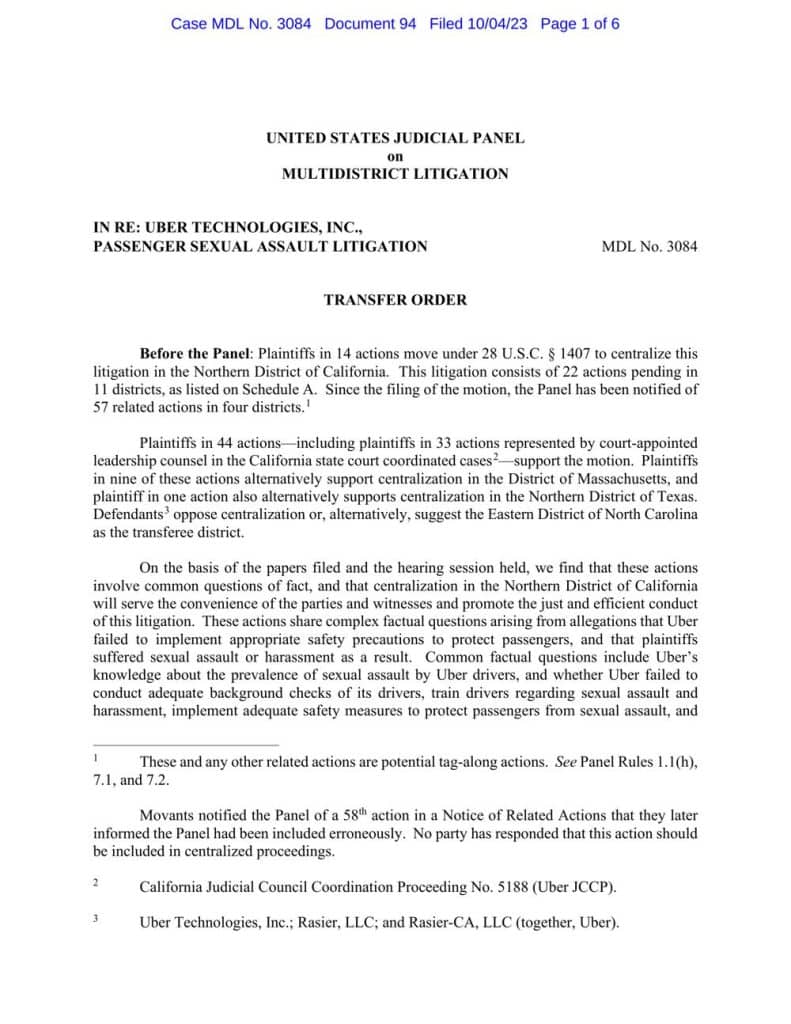
  • October 4, 2023 – The U.S. Judicial Panel on Multidistrict Litigation creates MDL No. 3084 in the Northern District of California to coordinate federal Uber passenger sexual assault lawsuits. The MDL initially included 79 cases.
  • March 10, 2025 – The Ninth Circuit rejects Uber’s challenge to the MDL, ruling that a private collective-action waiver could not override the federal panel’s authority to centralize cases for coordinated pretrial proceedings.
  • August 2025 – A New York Times investigation based on previously sealed court records reports that Uber received more than 400,000 sexual assault or sexual misconduct reports connected to U.S. trips from 2017 through 2022.
  • September 8, 2025 – First California state bellwether trial begins in San Francisco.
  • September 30, 2025 – Jury Finds Uber Negligent but Not Liable in First Sexual Assault Trial.
  • January 14, 2026 – First federal MDL bellwether trial begins in Phoenix.
  • February 5, 2026 – The first federal MDL bellwether trial ends with an $8.5 million compensatory-damages verdict for the survivor. The jury found Uber liable under an apparent agency theory but rejected the negligence and defective-design claims.
  • April 20, 2026 – The second federal Uber sexual assault bellwether trial ends with a North Carolina jury finding Uber liable for a driver’s conduct and awarding the survivor $5,000. Before trial, the judge ruled that Uber qualified as a common carrier under North Carolina law.
  • August 2026 – Nearly 4,000 lawsuits are pending in Uber MDL No. 3084, reflecting continued growth in the coordinated federal litigation.

Breaking News: Uber Sexual Assault Reports & Litigation

August 5, 2026 – Uber Attorney Ethical Tactics In Depositions Come Under Fire

According to the July 2026 report from the U.S. Judicial Panel on Multidistrict Litigation, 3,940 lawsuits were pending in MDL No. 3084 as of July 1. This is an increase of 369 cases from the previous month. The growing docket reflects the continued filing of claims by passengers who allege Uber failed to adequately screen drivers, respond to warning signs or implement reasonable rider-safety protections.

Attorneys are also preparing for another bellwether trial involving allegations arising from a 2020 ride in Texas. Uber has asked the court to prevent the plaintiff from pursuing punitive damages, arguing that Texas law limits such damages when the underlying conduct was committed by another person. The upcoming trial could provide another indication of how juries may evaluate Uber’s responsibility and influence negotiations involving thousands of unresolved claims.

Too little, too late? Uber is expanding its U.S. driver background check standards as the company continues to face thousands of lawsuits from passengers who allege they were sexually assaulted or harassed by drivers. The new policy broadens the list of criminal convictions that can disqualify drivers and couriers, including certain violent felonies, child abuse, endangerment, strangulation and stalking, and applies retroactively to existing workers. The unresolved question: why these stronger safeguards weren’t in place before passengers were harmed. [LEARN MORE]

A new shareholder lawsuit accuses Uber’s board and senior leadership of failing to take stronger action on rider safety while the company faced growing sexual assault allegations involving drivers. The lawsuit claims Uber considered safety measures such as in-car cameras and stronger background checks, but allegedly held back because those changes could interfere with its gig-worker business model. [SOURCE: BUSINESS INSIDER]

Uber and California trial attorneys have reached a deal that could keep their fight off the November ballot. The agreement mostly focuses on car crash claims and medical bills, but it also includes new safety standards for rideshare companies aimed at preventing sexual misconduct. Read our coverage here

Uber’s liability strategy has now expanded beyond the MDL and state-level court fights into federal transportation legislation. A new amendment added to the BUILD America 250 Act by Rep. Vince Fong would substantially limit rideshare-company liability for driver-caused harm unless plaintiffs can show gross negligence or criminal wrongdoing by the company itself. From a plaintiff-side perspective, the concern is that this could preempt or undercut state-law theories central to negligent hiring, common carrier, vicarious liability, and failure-to-protect claims. This includes sexual assault cases already pending against Uber. Uber and its allies are framing the measure as a response to meritless litigation and rising costs, but survivor advocates and consumer groups see it as an attempted federal liability shield that could make it much harder for passengers to hold the company accountable when safety systems allegedly fail. [SOURCE: Sacramento Bee]

Uber is now fighting to undo the two major sexual assault bellwether verdicts it has lost in federal court. In Arizona, Uber said it would appeal after a jury awarded $8.5 million to Jaylynn Dean, who alleged she was raped by an Uber driver in 2023. The jury found Uber liable under an apparent agency theory, although it rejected negligence claims and did not award punitive damages. In North Carolina, Uber has appealed a Charlotte jury’s $5,000 verdict for Brianna Mensing, who testified that an Uber driver grabbed her upper inner thigh during a 2019 ride. Uber argues that the North Carolina verdict was the result of legal and evidentiary errors, including the judge’s conclusion that Uber could be held responsible for rider assaults under state law. Together, the appeals show that Uber is not only contesting individual verdicts, but also trying to limit the legal theories that could shape thousands of pending passenger sexual assault claims in the broader federal litigation. [SOURCE: AOL]

A federal jury in North Carolina ordered Uber to pay $5,000 to a woman who said she was sexually assaulted by a driver, marking the second bellwether trial outcome in a growing wave of more than 3,300 consolidated federal cases. While the damages were relatively modest compared to the $8.5 million verdict in the first test case in Arizona, the decision adds to a developing pattern of juries finding Uber potentially liable for driver misconduct. The case also highlights key legal arguments that continue to shape the litigation, including whether Uber can be treated as a common carrier and held responsible for the actions of its drivers, as well as how juries assess harm and credibility. [SOURCE: Reuters]

Uber is seeking to overturn a tentative court ruling that could classify it as a “common carrier,” a designation that would impose a heightened duty to protect passenger safety as sexual assault litigation moves toward additional bellwether trials. The challenge comes amid mixed legal outcomes, including an $8.5 million verdict in the first federal MDL trial and separate California state cases where juries found Uber negligent but not liable for personal injury.  As courts weigh whether Uber functions as a transportation provider or a technology platform, the outcome of this dispute could significantly influence how future cases are argued, how juries are instructed, and the broader direction of settlement discussions.
[LEARN MORE ABOUT THIS STORY]

UPDATE (April 15):
A federal judge has ruled that Uber owes a non-delegable duty to its passengers, meaning the company may be held responsible for rider safety even when drivers are classified as independent contractors. The decision could significantly impact how liability is determined in future Uber sexual assault cases as litigation moves toward additional bellwether trials.

Uber is planning to tighten its background screening policies to permanently exclude individuals convicted of violent felonies, sexual offenses, and child or elder abuse from driving on its platform after investigations revealed its previous seven-year cutoff allowed drivers with serious criminal histories in many states, a change that comes as the company faces heightened scrutiny and litigation over rider safety. [SOURCE: NEW YORK TIMES]

A Yolo County, CA jury convicted an Uber driver of sexually assaulting a UC Davis student after a late night ride home, as national attention remains focused on Uber following the first federal jury verdict awarding $8.5 million to a survivor in a landmark civil trial. [SOURCE: ABC10]

A federal jury in Arizona awarded $8.5 million to a passenger who said she was sexually assaulted by an Uber driver, marking the first bellwether verdict among thousands of consolidated Uber sexual assault lawsuits. The jury found the driver acted as Uber’s agent, holding the company liable and creating a potential benchmark for future cases. [LEARN MORE]

A federal jury in Phoenix is deliberating in the first bellwether trial arising from the nationwide Uber sexual assault litigation, a closely watched case that could influence thousands of pending claims. The lawsuit alleges that Uber failed to protect a young woman who was sexually assaulted by her driver during a late-night ride in 2023, and that the company’s app lacked basic safety safeguards such as automatic recording and a women-preferred driver option. Jurors are weighing whether Uber was negligent, whether its app was defectively designed, and whether the driver acted as Uber’s apparent agent. The plaintiff is seeking $24 million in compensatory damages for long-term psychological harm and approximately $120 million in punitive damages, arguing a substantial verdict is necessary to force meaningful safety changes. The outcome could shape future trials, settlement strategy, and expectations for rideshare safety nationwide. [LEARN MORE]

A federal judge overseeing the Uber passenger sexual assault multidistrict litigation has refused Uber’s request to declare a mistrial in the first federal bellwether case, allowing the landmark trial to proceed toward a jury verdict. The ruling rejected arguments that jurors were improperly influenced, reinforcing the court’s position that the evidence presented, including statistical context about reported sexual assaults on the platform, is appropriate for jury consideration. The decision is a significant procedural setback for Uber and keeps a closely watched test case moving forward, with potential implications for thousands of federal and state lawsuits alleging the company failed to protect riders from foreseeable sexual assault risks. [LEARN MORE]

In the first Uber sexual assault lawsuit to reach a federal jury, the company defended its nonprofit safety partnerships and internal prevention efforts as survivors challenged whether those measures meaningfully reduced assaults on the platform. Testimony highlighted Uber’s spending on advocacy collaborations, internal marketing strategies targeting women riders, delayed safety feature rollouts, and ongoing criticism over driver screening practices.  [READ MORE]

In deposition footage played for jurors in the first federal Uber sexual assault case to reach trial, Uber CEO Dara Khosrowshahi repeatedly said he did not know or could not remember basic information about reported sexual assaults on the platform. Questioned about rising assault reports, risk factors tied to late night rides and intoxicated passengers, and whether Uber tracks or discloses that data, Khosrowshahi offered little substantive detail. The testimony comes as the plaintiff alleges Uber failed to implement reasonable safety measures that could have prevented her assault, raising broader questions about corporate oversight, transparency, and accountability in rideshare safety.

Click to learn more.

Federal jurors are hearing evidence in the first Uber sexual assault case to go to trial, including internal messages showing executives discussed suppressing negative press while acknowledging a growing number of sexual assault allegations involving drivers. A couple of gems from Uber’s global safety communications director, Andrew Hasbun in 2018: 

“In many cases, we can and should squash stories.”

“Kill stories when possible and mitigate the impact on our reputation.” 

Click to learn more.

Federal authorities in Houston have charged four Uber drivers in connection with alleged violent sexual assaults involving passengers, with investigators warning there may be additional victims who have not yet come forward. According to the FBI and the U.S. Department of Justice, the men are accused of abusing their position as rideshare drivers by kidnapping victims, driving them to unintended locations, or preventing them from exiting the vehicle, in some cases allegedly using force or strangulation. One suspect remains at large, and all of the drivers’ Uber accounts were reportedly deactivated after the incidents were reported. The cases are part of Operation Lighthouse, a federal initiative focused on addressing sexual abuse in rideshare settings, and authorities are urging anyone with information to contact the FBI. [SOURCE: Click2Houston]

The first bellwether trial in Uber’s nationwide sexual assault litigation is underway in Phoenix, where jurors are weighing claims that the company failed to prevent a driver from raping a passenger. The case is being closely watched because it could influence the outcome of more than 3,000 similar lawsuits pending against the rideshare giant. [LEARN MORE]

A New York Times investigation revealed that Uber knowingly approved drivers with violent criminal histories under a background check system designed to reduce costs and speed onboarding, even as the company received reports of sexual assault or misconduct nearly every eight minutes in the United States. Consumer advocates say internal documents show Uber executives were aware of the system’s deficiencies but declined to adopt stronger protections, exposing passengers, particularly those who were intoxicated, asleep, or otherwise vulnerable to serious harm. [SOURCE: New York Times]

A Bakersfield Uber driver has been charged with raping an unconscious passenger after allegedly continuing to drive her around Ventura County instead of taking her home.  [SOURCE: Bakersfield Now]

An Uber driver in Tempe has been arrested after police say he sexually assaulted a female passenger during a ride, forcing her to repeatedly tell him to stop and attempt to escape while the vehicle was still moving. The driver allegedly exposed himself, threw money at the victim, and fled the scene before later turning himself in and admitting to the assault. The case comes amid thousands of lawsuits nationwide accusing Uber of failing to protect riders, as well as ongoing scrutiny of the company’s safety practices and handling of sexual assault reports. [SOURCE: FOX 10 Phoenix]

Uber has asked a federal judge in the Northern District of California to postpone a scheduled bellwether trial in the nationwide sexual assault multidistrict litigation, arguing that a recent advertising campaign related to the lawsuits could unfairly influence potential jurors. The company claims the ads rely on misleading statistics about sexual assault reports on the platform and could prejudice the jury pool ahead of the test trial, which is intended to help guide thousands of similar cases. The motion comes as preparations for the first bellwether trial continue and as the broader litigation over Uber’s safety practices and handling of sexual assault reports moves forward.

In one of the most disturbing cases of rideshare driver assault, an Indianapolis Uber driver, Francisco Valadez, received a 45-year sentence after admitting he killed passenger Chanti Dixon during an attempted sexual assault in 2024. According to court records, Valadez attacked Dixon in the backseat of his vehicle, shot her, and was later linked to the crime through a police investigation.  [SOURCE: Hoodline.com]

A 61-year-old Uber driver, Clifford Partin, was arrested in Richmond, Kentucky, after a woman reported that she lost consciousness during an Uber ride on August 30 and later awoke in a parked car at the Richmond Centre, leading her to seek medical care and report the assault. Investigators say GPS data, surveillance footage, and a subsequent interview in which Partin admitted to the assault supported her account. He now faces charges, including first-degree rape incapable of consent. [SOURCE: LEX18.com]

Federal authorities arrested a 29-year-old Uber driver accused of sexually assaulting a passenger after she reported that he drove off-route, coerced her, and assaulted her behind a building at the Beltsville Agricultural Research Center. Investigators say the woman, who appeared disoriented when found, identified the driver through the rideshare app, and police later located and arrested him in District Heights. The arrest came just weeks after Baltimore Police had sought the same driver for questioning in an unrelated homicide. He now faces federal sexual abuse charges that carry a potential life sentence. [SOURCE: Baltimore Sun]

A University of Utah student reported that an Uber driver assaulted her on campus after picking her up for a ride near Research Park, leading to the driver’s arrest and an active police investigation. According to the probable cause statement, the student escaped the vehicle and contacted a friend before reporting the incident, and authorities say they have “substantial evidence.” Uber immediately removed the driver from the platform and stated it is assisting law enforcement. [SOURCE: Salt Lake Tribune]

A recent case in North Texas highlights ongoing risks for minors in rideshare vehicles. A 12-year-old girl in Frisco was assaulted by her Uber Health driver, Robert Johnson III during what should have been a safe medical transport arranged by a pediatric facility. After Johnson was convicted, the child’s mother spoke publicly to raise awareness, saying her daughter “doesn’t want this to happen to anyone else.”

Although minors are not supposed to ride alone under Uber’s own policies, the family believed the healthcare-arranged trip was safe. Safety advocates say Uber’s public assault statistics may paint an incomplete picture, and lawmakers continue pushing for stronger reporting requirements and child protection measures.

The Maricopa County Sheriff’s Office (MCSO) is searching for 33-year-old rideshare driver Lemolineaux Bain, accused of sexually assaulting a 21-year-old woman after she requested an Uber ride home following a night out with friends. According to MCSO, the woman’s parents interrupted the assault after the driver brought her home, prompting Bain to flee before law enforcement could question him. Investigators believe there may be additional victims and urge anyone with information to contact the Sheriff’s Office or provide anonymous tips through the 602-876-TIPS hotline.

WFLA News Channel 8 reports that an Uber driver in Miami has been charged with sexually assaulting a tourist who passed out in his car after allegedly being drugged. Rafael Martinez, 42, was arrested on October 21 and booked into Miami-Dade County Jail on one count of sexual battery of a physically helpless victim.

According to investigators, the incident occurred on January 25, 2024, when the victim, visiting from out of town, was drinking at a hotel bar with a friend. After her friend left, a man later identified as Martinez approached her outside and offered a ride, claiming he would log it into the Uber app afterward. The victim entered his car and accepted an open bottle of vitamin water from him. She soon began feeling dizzy and passed out.

The victim briefly awoke to find Martinez giving her a shot of alcohol before blacking out again. She later woke up naked in an unfamiliar apartment. Surveillance video confirmed she was brought to the Park Place by the Bay apartment complex with Martinez that night.

The victim managed to escape and report the assault. DNA from her rape kit matched Martinez, leading to his arrest more than a year later. Martinez remains in custody without bond.


Bloomberg Law reports that the legal team for a Florida woman who was sexually assaulted by her Uber driver in 2021 has accused the company of hiding key evidence about its handling of sexual assault incidents and driver safety practices. Her attorneys allege that Uber misled the court by denying the existence of internal data later revealed in separate California litigation showing thousands of reported assaults on the platform.

The plaintiff, identified as Jane Doe, was attacked by an Uber driver with a lengthy criminal record after being picked up outside a Tampa nightclub. The company has already been sanctioned for discovery violations, and the judge may now allow punitive damages if the court finds Uber engaged in intentional misconduct.

The Daily Journal reports that following a split verdict in the first Uber sexual assault bellwether trial, attorneys for the plaintiff plan to appeal after a San Francisco judge allowed evidence about her past sexual encounters to be presented to jurors. Her attorneys argue that this violated California’s Rape Shield Law, which was designed to protect survivors by keeping such evidence out of civil and criminal trials.

Why would a plaintiff’s past sexual history be a factor in deciding whether Uber is responsible for an assault? The judge reportedly allowed the defense to refer to certain events as “traumatic incidents,” which the plaintiff’s team says confused the jury and blurred the line between the survivor’s past experiences and the attack involving the Uber driver.

The first Uber sexual assault trial ended with a split verdict, with jurors finding Uber negligent but not legally responsible for damages. Despite the setback, the decision provides plaintiffs’ attorneys with valuable lessons on how to strengthen arguments and better frame causation in the many trials still to come.

Uber argued that the driver had passed background checks and carried strong rider ratings, portraying the assault as an unforeseeable criminal act. Plaintiffs’ attorneys pressed for Uber to be held to the same “common carrier” standard as buses and airlines, but jurors ultimately were not persuaded that Uber’s failures were a substantial factor in the attack. (Read our analysis of the trial here.)

This initial trial is only the beginning. Hundreds of similar claims are set for trial in California state court, while thousands more are moving forward in federal multi-district litigation before Judge Charles Breyer. Future cases will likely revisit these same arguments with sharper strategies, leaving the door open for survivors to achieve accountability.

The very first Uber driver sexual assault trial is now in the hands of the jury. Today, a San Francisco jury began deliberating on a verdict that could influence outcomes across coordinated Uber assault litigation, with hundreds of California trials hanging in the balance of this litigation, and a few thousand similar federal trails scheduled for early next year. The San Francisco Superior Court test trial will decide whether Uber can be held liable for a rider’s alleged sexual assault by a driver. In closing statements, the plaintiff argued Uber prioritized rapid growth over safety and asked for nearly $22 million plus punitive damages. Uber said assaults are extremely rare and that it used the highest care with background checks and monitoring. Survivors advocates counter that a recent report by the New York Times reveals over 400,000 instances of sexual misconduct or sexual assault; not exactly a rare occurrence. 

A House oversight subcommittee asked Uber to explain how it prevents, tracks, and responds to reports of sexual assault and misconduct on its platform. The request cites news reports that say Uber receives a report of sexual assault or sexual misconduct in the United States almost every eight minutes and that hundreds of thousands of trips from 2017 to 2022 were linked to such reports, far more than previously disclosed. The letter seeks details on policies, data accuracy, and any new measures to protect riders and drivers. It also points to Sami’s Law and a Government Accountability Office report noting that current data does not fully capture the scope of assaults in ridesharing.

Does this really matter for survivors of Uber sexual assault perpetrated by drivers? Maybe. Maybe not. On one hand, more scrutiny can push for clearer reporting, faster responses, and stronger safety tools. That can help survivors document what happened, find support, and pursue accountability through civil or criminal paths. On the other hand, hearings and letters do not guarantee real change. Company policies can take time to update, data can remain incomplete, and individual cases still depend on evidence, local law, and the quality of follow up. If you are a survivor, your best path is to focus on your options now while policymakers debate what comes next.

Two of the first federal bellwether trials in the Uber sexual assault multidistrict litigation (MDL) will now be held in the Western District of North Carolina, even though the MDL is based in Northern California. The move, authorized by Judge Charles Breyer and coordinated with the Judicial Panel on Multidistrict Litigation, is based on Uber’s Terms of Use and a venue transfer statute (28 U.S.C. § 1404(a)). While Judge Breyer will retain authority over the trials, this shift could significantly affect how juries view the evidence, especially in a state with a different cultural and legal climate than San Francisco.

For survivors, this matters because bellwether trials help determine the tone and potential settlement value of thousands of pending lawsuits. Regional jury attitudes, courtroom dynamics, and judicial norms can all influence outcomes. If Uber fares better in North Carolina, it could weaken plaintiffs’ leverage. If the trials result in strong verdicts for survivors, it could pressure Uber into broader accountability. Either way, moving high-stakes trials out of California adds a new layer of uncertainty. For both sides.

As the first Uber sexual assault trial in California state court moves forward, jurors have now heard from former Uber executives and safety staff about internal warnings that were allegedly ignored for years. Internal emails shown during the trial reveal that Uber employees pushed for stronger safety measures, including ride recordings, real-time location sharing, and a women-only ride option, as early as 2014. According to trial testimony, executives delayed those proposals due to legal concerns and fears they might signal the platform was unsafe.

The case involves an 18-year-old woman who says she was assaulted during a 2019 Uber ride to the San Jose airport. Plaintiffs allege Uber severely underreported sexual misconduct, citing internal estimates of up to 95,000 incidents in a single year, far more than what was published in its official safety reports.

Although this trial involves just one survivor, it could influence the broader litigation involving 600 similar claims consolidated in California Superior Court. The outcome may also impact how attorneys approach the separate federal multidistrict litigation (MDL), which now includes over 2,500 lawsuits. The first MDL trial is scheduled for January 2026.

The Department of Justice has filed a lawsuit in Northern California accusing Uber and its drivers of widespread violations of the Americans with Disabilities Act (ADA). The suit alleges that Uber routinely refuses rides to people using service animals or using mobility devices, charges cleaning or cancellation fees tied to disabilities, and fails to properly train drivers or enforce policies to accommodate passengers with disabilities. The DOJ is seeking $125 million in damages and changes in Uber’s practices.

What does this have to do with Uber sexual assault lawsuits? Seemingly, nothing directly. Yet’s it’s another example of Uber putting profit and operational convenience ahead of the rights, safety, and dignity of vulnerable users. This lawsuit echoes the concerns in the MDL that Uber has, according to plaintiffs, ignored internal warnings, underreported harms, and avoided implementing protections when doing so might reduce margins or create costs.

The first bellwether trial in California’s state-level Uber sexual assault litigation began yesterday in San Francisco Superior Court. The case centers on an 18-year-old college student who alleges she was groped and nearly raped by an Uber driver during a 2019 ride to the airport. Plaintiffs allege Uber ignored internal warnings and underreported as many as 95,000 sexual violence incidents in a single year. This trial is one of 600 lawsuits consolidated before Judge Ethan P. Schulman and will serve as a test case for future proceedings and potential settlements. A separate federal MDL is scheduled to begin its first trial in January 2026. The federal litigation was initially scheduled for December 2025 (see update below).

The first bellwether trial in the federal Uber sexual assault multidistrict litigation (MDL) has been postponed to January 6, 2026. The delay, approved by U.S. District Judge Charles Breyer, follows unresolved discovery issues involving the plaintiff’s smartphone data and evidence preservation. The federal MDL, which includes more than 2,500 consolidated lawsuits in the Northern District of California, parallels a smaller wave of litigation (roughly 600 lawsuits) in California State court over alleged sexual assaults by Uber drivers. A separate bellwether trial in California state court began yesterday (see update above). The outcomes of both trials may help shape future settlements or verdicts.

A Rosemont, CA woman called an Uber after attending a concert in Sacramento and became sick during the ride, ABC 10 reported. The lawsuit alleges the driver left her near a gas station alone, intoxicated, and without her phone, eight miles from home. She was then approached by strangers who abducted her; she escaped after being assaulted at knifepoint and reached safety at a nearby school the next morning. The complaint faults Uber for abandoning a vulnerable passenger with no follow-up after her mother reported the incident. Uber responded that it “cannot comment on pending litigation” but is committed to rider safety. This case is a textbook representation of why so many survivors have filed claims against Uber; vulnerable riders deserve protection, not abandonment.

New local cases keep surfacing that remind us why Uber recieved over 400,000 reports of sexual misconduct or assault–from 2017 through 2022 alone. CBS Austin reported that Uber driver identified as Nawar Al Issa, 38, has been charged with attempted sexual assault after a November 2024 incident involving a female passenger in South Austin. According to police, the victim’s fiancé tracked her location to their apartment complex and found Al Issa in the back seat of his car with the unresponsive passenger. A Sexual Assault Nurse Examination later revealed DNA evidence linking him to the victim. Al Issa was arrested and is facing charges of attempted sexual assault, a third-degree felony.

While it may not directly impact the Uber driver sexual assault litigation, Uber’s newly launched Women Preferences pilot program offers insight into why the lawsuit wave exists in the first place. Having launched this summer in Los Angeles, San Francisco, and Detroit, the feature allows women riders to request to be matched only with women drivers. Women drivers can also opt to accept only women riders during certain hours. Tyla.com reports that social media users quickly noticed that, visually, the women-only rides appeared to show lower pricing compared to other options. For passengers, that’s advantageous. However, for drivers, lower fares mean lower tips. 

Other areas of concern: Uber noted it ‘cannot guarantee that all Users you are matched with while using this feature will be women, or appear in a way that you would identify as a woman’. Uber adds, “Please be mindful that the Uber community is remarkably diverse, including people of all gender identities and expressions. Some women Users may not express their gender or appear in a way that matches your perception of ‘femininity.'”

The first bellwether trial in the Uber passenger sexual assault multidistrict litigation (MDL No. 3084) is scheduled to begin December 8, 2025, with Dean v. Uber selected as the lead case. In her complaint, an Arizona woman alleges she was raped by an Uber driver after the company failed to act on prior reports of the driver’s misconduct.

A Montgomery County, PA Uber driver, 26-year-old Mirvan Dinler, is facing multiple charges after allegedly assaulting a Villanova University student in her dorm room in September 2024. The 21-year-old student testified that she had no memory of the ride after leaving a Philadelphia club and awoke to find Dinler in her room. Investigators say campus security footage and access card records show Dinler accompanying her into the building. Prosecutors had offered a plea deal of four to eight years in prison in exchange for reduced charges, but Dinler rejected the agreement. A trial is scheduled to begin January 26.

An Uber driver in Texas, Sameh Mohamad Chami, 49, has been arrested and charged with aggravated kidnapping after allegedly sexually assaulting a 21-year-old passenger. Police say the woman had requested a ride home but instead was taken to an empty parking lot. Authorities later confirmed that Chami, a Lebanese national, had overstayed a tourist visa by more than three years. Following his arrest, Immigration and Customs Enforcement (ICE) issued a detainer to transfer him into federal custody.

In one of the biggest developments in the Uber sexual assault litigation, the New York Times obtained unsealed court documents that reveal the scope of the problem verges on epidemic proportions. (Here’s our summary of the NYT investigation.) While Uber’s own public safety reports from 2017–2022 admitted to 12,522 serious sexual assault incidents, the newly revealed internal records show a staggering 400,181 reports of sexual misconduct during that same period. This figure is over 3,000% higher than the figures Uber disclosed.

And for those that believe sexual misconduct isn’t serious, imagine being a woman — as most victims are — who booked what should have been a safe, uneventful ride home. Instead, you find yourself groped or subjected to lewd, inappropriate comments from your driver, your sense of safety shattered in an instant. We can only guess how many cases of sexual inpropriety were not reported; the number of incidents is likely much higher. 

One of the latest cases occurred in Texas on August 6, when 49-year-old Uber driver Sameh Chami, a migrant with an ICE detainer, was arrested and charged with aggravated kidnapping after allegedly assaulting a 21-year-old passenger. The woman had scheduled a ride from Galveston to her home in Friendswood in the early morning hours. Her family, tracking her trip via the Life360 app, saw the ride marked as “completed” at her residence — but her location showed otherwise. They found her in Chami’s car in an empty business parking lot, got her out, and took her home. Despite being intoxicated, she recalled Chami reaching into her pants. Police allege he intentionally ended the ride in the Uber app before the assault. Chami remains in custody.

Another recent rideshare sexual assault occurred in upstate New York, where local media reports that Thomas F. Cipriano, of Halfmoon, NY was arrested on August 7 for allegedly sexually assaulting a minor male passenger. According to the Saratoga County Sherrif’s Office, Cipriano was charged with felony second-degree attempted rape, unlawful imprisonment, and misdemeanor endangering the welfare of a child.

Late yesterday, A California judge denied Uber’s attempt to dismiss hundreds of sexual assault lawsuits, ruling that the  company can be held to the same legal standard as a common carrier, Bloomberg Law reported. Judge Ethan P. Schulman of the San Francisco Superior Court found that Uber owes its passengers the “utmost care and diligence,” similar to a taxi or train service.

This decision clears the way for the first bellwether jury trial in the consolidated state court proceeding, which includes over 500 individual lawsuits filed by California passengers who say they were sexually assaulted by Uber drivers. That trial is scheduled to begin on September 8.

The ruling is a significant legal setback for Uber, which had argued it bears no duty to prevent unforeseeable criminal acts by independent drivers. The case runs parallel to ongoing federal multidistrict litigation in the Northern District of California, which includes more than 2,500 similar lawsuits from across the U.S.

As Uber prepares to roll out a “Women Preferences” feature in Los Angeles, San Francisco, and Detroit, the company faces renewed scrutiny from survivor advocates and plaintiff attorneys. While the pilot allows women riders and drivers to opt for same-gender matches, critics say it’s a long-overdue step that doesn’t address deeper systemic failures. The update follows a July 2025 ruling in the Uber MDL, where a judge allowed certain product liability claims, citing the lack of gender-matching options, to proceed toward trial.

Although not as high-profile as recent developments in the Uber MDL bellwether trials (see next news update below), this local case is a stark reminder of why thousands of survivors have filed lawsuits against the rideshare giant. In Connecticut, a 17-year-old girl reported being sexually assaulted by her Uber driver in March 2025. Following an investigation, the driver—33-year-old Edgar Interiano of Norwalk—was arrested and charged with second-degree sexual assault, in addition to reckless endangerment and providing liquor to a minor. He remains in custody on $100,000 bond.

U.S. District Judge Charles Breyer, who is overseeing the Uber Driver Sexual Assault Multidistrict Litigation (MDL) has ordered that 12 of the 20 bellwether trial cases be transferred back to the states where the assaults occurred, citing the enforceability of Uber’s forum-selection clause in its Terms of Use. These clauses require disputes to be tried in the rider’s home jurisdiction. While unusual for an MDL—where bellwether trials are typically held in the central court—this decision does not dissolve the MDL itself, which still includes more than 2,800 lawsuits.

For plaintiff survivors, this ruling is mixed. On one hand, plaintiffs may benefit from trying their cases in home-state courts, which might offer local juries more sympathetic to community safety concerns. On the other hand, this splinters the bellwether process, which was designed to streamline outcomes and encourage early settlement. It may delay trial timelines and reduce pressure on Uber to settle en masse. That said, the core claims, alleging Uber failed to protect passengers from known risks, remain intact and will continue to be litigated aggressively in both federal and state courts.

As for why the eight other test cases were not remanded? It could have been for several reasons including the clause did not exist or apply at the time of the ride (Uber’s terms have changed over the years); the user wasn’t the account holder (e.g., a parent ordered the ride, but the survivor was the minor child); the clause was unconscionable or unenforceable under state law (e.g., it was buried in small print or contradicted public policy); or the lawsuit contains claims beyond the scope of the clause, such as third-party liability or product liability claims.

In a recent court ruling, Uber convinced a judge to dismiss one of the 20 bellwether lawsuits in the federal sexual assault litigation and exclude some legal claims. This may sound like bad news for the plaintiffs and future claimants. But the reality is that the core claims and arguments remain valid. The judge presiding over the consolidation of at least 2,359 federal Uber sexual assault cases in the multidistrict litigation, Judge Charles Breyer, ruled that claims accusing Uber of fraud in its advertising will not be heard. But the central issue remains: Uber is still being accused of failing to warn passengers about dangerous drivers and misrepresenting the safety of its platform. That argument, known as “fraud by omission,” is the backbone of the MDL as well as hundreds of similar lawsuits in state courts. Again, considering that Uber has tried to break up the MDL, this is latest development is not a pitfall for plaintiffs.

In other Uber driver sexual assault developments, a new lawsuit was filed in Louisiana by a woman who says she was assaulted by an Uber driver in New Orleans in August 2024.

The Uber sexual assault litigation continues to grow rapidly, with 2,359 cases now filed in the federal multidistrict litigation (MDL) and over 600 more in California’s coordinated state court action (JCCP), bringing the total number of lawsuits to nearly 3,000. 

Last month, eight new plaintiffs from across California filed a lawsuit in San Francisco Superior Court, alleging that Uber enabled their assaults by prioritizing growth over passenger safety. If these allegations sound like a broken record, it’s for a good reason. From relying on third-party vendors and digital checks that can miss prior criminal behavior to resisting safety features like in-car cameras or female-only driver options, Uber has repeatedly prioritized growth and cost-cutting over basic passenger protections, even after receiving multiple assault complaints about the same drivers.

A federal magistrate judge has ordered Checkr and Accurate Background to hand over background check reports for Uber drivers accused of sexual assault in the ongoing MDL bellwether cases. These records, treated as “attorneys’‑eyes‑only,” could help establish whether Uber overlooked red flags during driver screening, central to plaintiffs’ claims of systemic negligence.

The Uber sexual assault litigation continues to expand, with over 2,800 lawsuits now active across federal and state courts—2,229 in the federal MDL and 619 in California’s coordinated proceeding (JCCP), which is the state equivalent of an MDL. This sharp rise reinforces allegations that Uber’s failure to prevent driver sexual misconduct is systemic, not sporadic.

Meanwhile, legal efforts are intensifying behind the scenes. Plaintiffs are pushing for access to background checks from Checkr and Accurate Background, two screening companies hired by Uber. Both have refused to comply without a court order, triggering a potential legal showdown. And in a major procedural development, a Settlement Master has been appointed (Judge Gail Andler), signaling that early negotiations are underway and that Uber may be preparing for a global resolution.

Law360 reports that Uber is trying to move 13 of the 20 sexual assault cases out of California, where the federal multidistrict litigation (MDL) is based. The company claims its terms of service require lawsuits to be heard in the state where each incident happened, such as AlabamaGeorgiaPennsylvania, etc.

But Uber’s tactic undermines the entire point of consolidating these cases into a single court: to expose systemic safety failures and hold the company accountable in one coordinated effort.

The cases were carefully selected by both sides under court supervision. They’ve already gone through months of discovery. Scattering them now would waste judicial resources, create delays, and risk inconsistent outcomes—all while benefiting the defendant.

Courts don’t always honor forum-selection clauses when they conflict with the public interest. Uber’s push to enforce them mid-litigation looks more like a strategic escape hatch than a legitimate legal argument.

At a hearing for the Uber Driver Sexual Assault MDL #3084 held earlier this month, Judge Charles Breyer made several important decisions about what plaintiffs’ lawyers can ask Uber in upcoming sworn depositions.

The plaintiffs had asked to question Uber about its past data deletion practices and whether the company had improperly used attorney-client privilege to hide information—claims they say point to a long-running cover-up. Uber pushed back, calling the requests too broad and based on speculation.

Judge Breyer issued a mixed ruling. He did not block the questions entirely, but did limit them. Plaintiffs can ask about Uber’s actual data retention policies and any missing documents tied to the case. However, they can’t ask questions based purely on rumors, books, or hearsay—such as claims from the book Super Pumped.

The judge also denied a request to force Uber executives to bring laptops and give live walkthroughs of company systems during depositions, saying that’s not allowed under court rules. If plaintiffs want to examine Uber’s systems, they’ll need to schedule that separately.

Lastly, Uber tried to reduce the amount of time its corporate witnesses must sit for questioning—from 10.5 hours to just 7. The judge rejected that request, saying Uber must follow the same rules previously set for all parties in the case.

Theodore Halls, Jr., a former Uber driver in Alabama is on trial for allegedly sexually assaulting two women during separate rides in 2020 and 2022. Both women were picked up near Auburn University and were reportedly unable to consent due to intoxication. Dashcam video and digital forensic evidence have become central to the prosecution’s case. Investigators say one of the women had no memory of the incident until she was later contacted by police after footage was recovered. The defendant, who remains in custody, faces multiple felony charges. One victim has reportedly settled a civil case with Uber, while the other lawsuit remains pending.

[June 17 update: WTVM (ABC 9) reports that Halls, Jr. was sentenced to more than 35 years in prison.]

The first bellwether trial in the Uber sexual assault multidistrict litigation (MDL #3084) is scheduled to begin on December 8, 2025, in the Northern District of California. U.S. District Judge Charles R. Breyer has selected six representative lawsuits involving a range of alleged assaults—from verbal harassment to rape—to test how juries respond to recurring claims in the broader litigation. The outcomes of these early trials will play a key role in shaping potential settlement strategies and guiding the resolution of more than 2,000 similar lawsuits pending against Uber.

At the end of March, 1,883 Uber driver sexual assault claims were consolidated in the multidistrict litigation (MDL). One month later, the number of claims surged 9.5%. There are now 2,062 active claims consolidated before Judge Charles Breyer in the Northern District of California in MDL #3084.

Police say 22-year-old Charles Willis used Uber to transport a 14-year-old girl from Barry County, Michigan, to his home in Northville. Authorities allege he unlawfully detained the girl and committed acts of abuse. Willis, who was reportedly already facing charges related to a prior incident, allegedly arranged and paid for the long-distance trip using the Uber app.

Although Uber’s policy prohibits unaccompanied minors from using the platform without adult supervision, questions persist about how well these rules are enforced. Investigators are reviewing how Willis was able to book the ride and whether the driver identified any warning signs. Law enforcement and safety experts continue to warn that rideshare apps are increasingly being misused by individuals targeting vulnerable users, including minors.

Police in Montgomery County have arrested Janaka Manatunga, 56, for allegedly assaulting a woman while working as an Uber driver. He was booked into the Montgomery County Jail on related charges, according to the Montgomery County Sheriff’s Office.

Investigators said the incident occurred near Market Street in The Woodlands, according to local media reports in Houston.

A female driver was allegedly sexually assaulted by a male passenger who requested a ride in North Seekonk. Upon arrival, he reportedly directed her down a secluded driveway, where he attempted to sexually assault her. The driver managed to escape by accelerating the vehicle, causing the assailant to flee. Police later arrested the suspect, James D. Oakes, 25, charging him with multiple offenses, including attempted sexual assault and kidnapping.

While you usually hear about passengers getting assaulted by Uber drivers, this case is different. It shows that drivers can be victims too. Some drivers have even taken legal action against Uber, saying the company didn’t do enough to protect them. Uber has tried adding things like an emergency button in the app and GPS tracking, but some drivers have voiced concern, claiming these actions are still not enough. Drivers are putting themselves at risk every time they pick someone up — and they deserve real protection, not just a few features on a phone. Rideshare sexual assault attorneys can also represent drivers. If you’re a rideshare driver who has been assaulted, take the first step of finding out what your legal rights are by filling out a brief, confidential form

Uber has threatened to shut down operations in Colorado if House Bill 1291 becomes law. The bill would impose new rideshare safety rules, such as mandatory background checks every six months, faster investigation of driver complaints, and audio/video recording of all rides. Uber claims the requirements are technically unworkable and would risk rider privacy, while supporters of the bill argue that these reforms are necessary to address rampant sexual assault issues tied to rideshare platforms.

This debate comes as Uber faces nearly 2,000 sexual assault lawsuits consolidated in federal court. Survivors and lawmakers argue that Uber’s pushback proves the company prioritizes profits over safety.

The Federal Trade Commission (FTC) has filed a lawsuit accusing Uber of deceptive billing practices tied to its Uber One subscription service. According to the FTC complaint, users were enrolled without consent, billed before free trials ended, and forced to navigate up to 23 screens to cancel a subscription that was advertised as “cancel anytime.” Some users said they were charged despite never knowingly signing up—or even having an Uber account.

Why does this matter for Uber sexual assault survivors? It reveals a troubling pattern: a company willing to prioritize profits at the expense of transparency and safety. Whether it’s burying critical terms in greyed-out text or fighting to keep sexual assault claims in arbitration, Uber’s behavior shows a consistent disregard for user rights.

A lawsuit filed by the family of a 13-year-old girl who was dropped off by an Uber driver and then sexually assaulted has reached a confidential settlement. The incident occurred in 2021 after the girl was picked up around 1:30 a.m. in Ventura and dropped off in the Harvard Heights section of Los Angeles, where the assault occurred. Although Uber denied liability, the case highlights the rideshare giant’s ongoing legal challenges. The settlement adds to growing scrutiny over Uber’s safety practices, as more than 1,900 similar claims are now centralized in a federal MDL.

Plaintiffs in the Uber sexual assault multidistrict litigation (MDL) filed a request asking U.S. District Judge Charles R. Breyer to consolidate multiple survivor claims for the first bellwether trial scheduled for December 2025. Uber opposes this request, arguing that each case should be tried individually. Plaintiffs argue that shared facts—such as Uber’s failure to mandate cameras, vet drivers properly, or address safety concerns—make consolidation appropriate for judicial efficiency. If the judge grants this request, multiple survivors could present their cases together, which may shape the outcome of future Uber sexual assault settlement negotiations. For plaintiffs, this could mean a more powerful platform to demonstrate systemic failure and increase potential compensation through stronger, unified testimony.

Following the addition of three dozen cases in February, the Uber sexual assault MDL added 283 cases in March, bringing the total of consolidated federal cases (Uber Technologies, Passenger Sexual Assault Multidistrict Litigation; MDL No. 3084) to 1,883.

Colorado House Bill 1291 aims to strengthen safety rules for Uber and Lyft by requiring more frequent driver background checks, faster response times to complaints, and mandatory audio/video recording during rides. The legislation is supported by Rep. Jenny Willford, who filed a lawsuit against Lyft after her own experience with sexual assault by a rideshare driver. Survivors and advocates say the bill is long overdue and necessary to hold rideshare companies accountable for rider safety.

Uber driver sexual assaults are also taking place all-too-frequently north of the border. CTV reports that an Uber driver who is a resident of the Toronto suburb of Oakville, Ontario, has been arrested for sexual assault of an Uber passenger. Hassan Ali Khan, 24, is believed by investigators to have sexually assaulted additional victims. Investigators are asking anyone with information to come forward, and to keep in mind that there is no statute of limitation when it comes to reporting sexual assault in Ontario. In most U.S. states, survivors of sexual assault have more time than ever to come forward as state legislators have become increasingly trauma-informed.

Frantz Fleureme, 32, allegedly propositioned the victim, grabbed her hand and tried to force her to inappropriately touch him during the ride, which occurred on March 1, according to Middletown Borough Police.

A 23-year-old woman in East Hartford, Connecticut, was allegedly sexually assaulted by her Uber driver just seconds after beginning her ride around 4 a.m. The driver, identified as Isaac Boafo, reportedly pulled into a restaurant parking lot, climbed into the back seat, and assaulted the passenger. The victim fought back, escaped the vehicle, and contacted police after a second Uber driver advised her to call 911. Boafo was later arrested and charged with first-degree sexual assault and disorderly conduct.

Philadelphia resident Angel Lopez was arrested for allegedly arranging an Uber to transport a 13-year-old girl from Western Pennsylvania to his apartment, where he drugged the girl and committed sexual offenses. Authorities say the two met via TikTok. The case highlights how rideshare services like Uber are not doing enough to prevent the sexual exploitation of minors.

Uber driver Joseph Graston was found guilty of unlawful sexual contact and unlawful touching. His arrest stems from a June 2022 incident in which a woman took an Uber home from a Bangor nightclub and later reported she was sexually assaulted by the driver. This case adds to the growing national scrutiny over Uber’s safety practices and comes amid ongoing federal litigation involving 1,600 Uber sexual assault lawsuits.

Nevada lawmakers fast-tracked AB523, a bill that limits Uber’s liability for harm caused by its drivers or passengers, provided the company maintains at least $1 million in insurance coverage during rides—a reduction from the prior $1.5 million minimum. The bill is part of a six-year truce between Uber and the Nevada Justice Association, ending a heated legal and political fight. However, the bill does not shield Uber from ongoing lawsuits in the California multidistrict litigation (MDL), where the company faces over 1,600 sexual assault claims, including from survivors in Nevada.

A federal judge has ordered top Uber executives—including current CEO Dara Khosrowshahi and co-founder Travis Kalanick—to testify under oath in depositions for the Uber sexual assault multi-district litigation, which consolidates more than 1,600 cases filed by riders who allege they were sexually assaulted by Uber drivers. The ruling rejects Uber’s attempt to shield its leadership from depositions, stating that key safety decisions were made at the highest levels. Survivors claim Uber failed to vet drivers properly and falsely marketed its platform as safe.

A Georgia mother filed a lawsuit against Uber in Gwinnett County, alleging the company’s failure to implement proper safety measures enabled her 14-year-old daughter to be exploited after being transported by an Uber driver to meet a 24-year-old man now facing criminal charges. The lawsuit accuses Uber of negligence, asserting that the company prioritizes avoiding liability over protecting minors. This case adds to growing scrutiny of Uber’s handling of rider safety, especially involving minors, and comes as the company faces over 1,600 federal sexual assault cases consolidated into multidistrict litigation (MDL) in California—an effort Uber unsuccessfully tried to dismiss.

CBS News Miami reported that Uber driver Yaroslandys Romero, 35, who has been accused of sexually assaulting a female passenger, appeared in bond court after his arrest. Charged with sexual battery, battery and indecent exposure, Romero, according to an arrest report, picked up the victim from a friend’s house and initially drove as she sat in the backseat. After she had requested a phone charger, he suggested she move to the front seat to be closer to his phone. Once she sat up front, Romero allegedly began touching her arm and asked for a kiss. From there, the sexual assault took
place. 

The Los Angeles Times reports that the Ninth Circuit Court of Appeals has denied Uber’s petition to break up the consolidated sexual assault lawsuits in the Multidistrict Litigation (MDL 3084). Uber had sought a writ of mandamus to overturn the Judicial Panel on Multidistrict Litigation’s (JPML) decision to centralize the cases under 28 U.S.C. § 1407, arguing that the lawsuits should not be grouped together. The Ninth Circuit rejected Uber’s request, ruling that the JPML had not committed legal error or abused its discretion in deciding to consolidate the claims.

The MDL consists of lawsuits filed by survivors of sexual assault and harassment who allege that Uber failed to take reasonable steps to prevent misconduct by its drivers. Uber argued that its collective action waiver—a clause in its terms of service that prevents customers from filing joint lawsuits—should block centralization. However, the Ninth Circuit ruled that Uber’s private agreements could not override the authority granted to the JPML under federal law. The court also clarified that, unlike class actions, MDL cases do not need to have common questions of fact that predominate over individual ones, reinforcing the legitimacy of consolidating these lawsuits. This decision allows the Uber sexual assault MDL to proceed in federal court as a centralized legal action.

Two new lawsuits filed in San Francisco Superior Court accuse Uber of negligence and false advertising, alleging the company failed to implement effective safety measures despite knowing that drivers were sexually assaulting passengers. The lawsuits involve 27 reported incidents from 2017 to 2024 and were brought by a total of 27 plaintiffs—24 women and three men in California and New York, the San Francisco Standard reported.

One lawsuit, filed by 21 women and two men, argues that Uber misrepresented its safety policies, particularly when marketing to vulnerable riders, such as intoxicated passengers and women traveling alone. The second lawsuit, filed by three women and one man, includes similar allegations of Uber failing to screen drivers properly and allowing repeated safety failures.

Both cases cite Uber’s 2019 Safety Report, which admitted that sexual assaults had occurred, yet plaintiffs argue the company continued neglecting proper driver screening and passenger protections. The lawsuits seek to hold Uber accountable under negligence and consumer protection laws, claiming the company’s failure to act responsibly put passengers at risk. Uber declined to comment on the litigation but stated it is working to improve safety measures.

Reading the latest headlines can be emotionally taxing. Learning about your legal options can be a more manageable first step. Thousands of Uber sexual assault lawsuits are moving forward, and filing deadlines vary by state, so survivors may wish to have their circumstances reviewed before assuming it is too late.

How Widespread Is Uber’s Sexual Assault Problem?

Uber operates in over 10,000 cities worldwide, completing millions of rides every day. But here’s the disturbing reality:

  • Uber receives thousands of sexual assault reports each year — according to their own data.
  • Hundreds of Uber drivers have been arrested or charged for sexual misconduct against passengers.
  • Many survivors describe similar patterns: a driver taking a vulnerable passenger to a secluded location and assaulting them.

Survivors and legal experts say that Uber’s background check system is deeply flawed, allowing predators to slip through the cracks.

Worried female passenger questioning an Uber driver during a ride in a tense moment
Even before an incident occurs, many passengers report feeling uncomfortable or unsafe—especially when drivers deviate from the route or act suspiciously. Survivors of Uber driver sexual assault say the warning signs were often ignored by the company.

Uber Sexual Assault Lawsuits Allege a Pattern of Putting Growth Before Safety

Uber sexual assault lawsuits allege that the company prioritized rapid expansion and driver recruitment over passenger safety. Plaintiffs argue that Uber’s business model placed enormous pressure on the company to add drivers quickly while relying on screening procedures that were less rigorous than those required in many traditional taxi systems.

Lawsuits and California prosecutors also accused Uber of misleading riders about the strength of its background checks and safety practices. Beginning in 2014, the company charged many passengers a “Safe Rides Fee,” generally starting at $1 per trip, which Uber said helped cover background checks, safety initiatives, and support services. Court records later indicated that Uber collected close to $500 million through those fees, prompting questions about whether riders received the enhanced protection they believed they were paying for.

Critics argued that the fee created an expectation of greater safety even though Uber’s screening process did not include some safeguards used by traditional taxi regulators, including fingerprint-based checks in many jurisdictions. To critics and plaintiffs, it looked less like added protection and more like safety-themed marketing.

In April 2016, Uber resolved a case brought by the Los Angeles and San Francisco district attorneys [PDF link] over allegedly misleading background-check and safety claims. Uber agreed to pay $10 million, with an additional $15 million potentially due if it failed to comply with the settlement. The agreement restricted Uber from describing its service as “the safest ride on the road” or its background checks as the “gold standard” without adequate support.

Separately, Uber proposed paying $28.5 million to resolve passenger class actions involving its “Safe Rides Fee” and related safety advertising. That initial proposal was rejected, and the related litigation later ended in a separate settlement.

How Uber’s Driver-Screening Practices Came Under Scrutiny

Uber’s driver-screening system has changed over time, but its historical practices and safety oversight have become central issues in sexual assault litigation.

No universal fingerprint requirement: Uber historically opposed mandatory fingerprint-based screening and instead relied primarily on name-based checks performed by third-party vendors. Taxi drivers in many jurisdictions were subject to fingerprinting, which some regulators and law-enforcement officials viewed as a more reliable way to confirm identity and uncover criminal records.

Remote third-party screening: Prospective drivers submitted identifying information remotely, and private background-check vendors searched criminal and driving records. Critics argued that the process could be completed quickly and might miss records that fingerprint-based or in-person systems could uncover.

No traditional in-person hiring interview: Uber’s app-based model generally allowed prospective drivers to complete screening and onboarding remotely rather than through a face-to-face employment interview.

Questions about training and supervision: Lawsuits have alleged that Uber failed to provide sufficient training, monitoring, and enforcement concerning passenger boundaries, intoxicated riders, misconduct reports, and sexual assault prevention.

Critics and plaintiffs argue that weaknesses in Uber’s screening and monitoring systems allowed some drivers with disqualifying histories or warning signs to reach or remain on the platform. Lawsuits further allege that inadequate responses to complaints exposed additional passengers to foreseeable risks.

A 2018 CNN investigation found that at least 103 Uber drivers in the United States had been accused of sexually assaulting or abusing passengers during the preceding four years. The investigation drew on police reports and court records from 20 major cities.

And that investigation captured only an early portion of the allegations. Since 2018, thousands of survivors have filed lawsuits claiming that Uber’s screening, monitoring, complaint-response, and safety systems failed to prevent foreseeable harm. The federal litigation now includes nearly 4,000 pending cases, [PDF link] alongside additional lawsuits in state courts.

More survivors are coming forward to seek accountability and safer rideshare practices. Every lawsuit adds to the pressure for meaningful change. If you are ready to explore your legal options, you are not alone.

California Regulators Penalized Uber Over Sexual Assault Reporting

Survivors’ reports and public scrutiny have also prompted regulatory action. In 2021, the California Public Utilities Commission approved a settlement requiring Uber to pay $9 million toward victim support and passenger-safety initiatives after the company failed to respond fully to requests for information about sexual assault and harassment reports.

What the $9 Million CPUC Settlement Required

In December 2021, the California Public Utilities Commission approved a settlement resolving an enforcement proceeding over Uber’s failure to respond to regulatory requests for information about sexual assault and harassment incidents listed in its 2019 U.S. Safety Report. Uber had raised concerns that releasing survivor-level information could compromise privacy.

Under the agreement, Uber paid $5 million to the California Victim Compensation Board and $4 million toward industry research, reporting practices, education, training, and violence-prevention initiatives. Uber also paid a separate $150,000 fine and agreed to provide future data through a system designed to protect survivors’ identities.

Reading about sexual assault reports and institutional failures can be emotionally difficult. Survivors may choose to focus on the steps that feel manageable to them, whether that means learning about their rights, speaking with an attorney, or seeking support from a trusted advocacy or counseling resource.

Whether you are considering legal action, looking for survivor-support resources, or simply trying to understand your options, you do not have to make a decision immediately or navigate the process alone.

The Fight for Justice: Survivors Take Uber to Court

Judge striking gavel with legal scale in background representing Uber sexual assault litigation.
Thousands of sexual assault lawsuits against Uber are part of a federal multidistrict litigation, with the first bellwether trial resulting in an $8.5 million verdict for the survivor, marking a significant early result in the coordinated litigation.

Can I Sue Uber for Sexual Assault? Legal Grounds Explained.

If an Uber driver sexually assaulted you, you may have legal grounds to pursue claims against the driver and, depending on the facts, Uber. Lawsuits against Uber commonly allege that the company:

  • Failed to adequately screen or monitor drivers
  • Allowed drivers to remain on the platform after complaints or warning signs
  • Misrepresented the strength of its passenger-safety practices
  • Failed to adopt or enforce sufficient policies addressing sexual misconduct
  • Failed to use available safety measures that could help deter misconduct or document what occurred

Whether Uber may be held legally responsible depends on the evidence, applicable state law, the relationship between Uber and the driver, and the legal theories available in the case.


Is There an Uber Driver Sexual Assault Class Action Lawsuit?

No. Uber sexual assault lawsuits are not currently proceeding as one nationwide class action.

Class actions are generally best suited to claims in which a large group of people experienced substantially similar harm caused by the same conduct. Sexual assault lawsuits are highly individualized. Each survivor’s experience, injuries, evidence, filing deadline, damages, and legal claims may be different.

A class action would also place major decisions in the hands of class representatives and class counsel. Although class-action settlements do not always pay every member exactly the same amount, compensation is typically determined through a group-wide settlement structure rather than through an individualized assessment of each survivor’s full damages.

For survivors who experienced severe physical, psychological, financial, or long-term harm, an individual lawsuit may allow those damages to be evaluated more fully. No particular settlement or verdict is guaranteed.


How the Uber Sexual Assault MDL Differs From a Class Action

Thousands of federal Uber sexual assault lawsuits have been consolidated in Multidistrict Litigation No. 3084. An MDL is not a class action.

In the MDL, each survivor keeps a separate lawsuit. The cases are coordinated before one federal judge for shared pretrial matters such as discovery, expert evidence, motions, and bellwether trials. Each case may still have its own settlement, verdict, dismissal, or eventual trial.

The MDL was created to reduce duplicative proceedings and inconsistent pretrial rulings—not to force every survivor into one case or one settlement. The Ninth Circuit later rejected Uber’s argument that a contractual collective-action waiver prevented federal courts from coordinating the lawsuits through the MDL process.


Uber’s History of Mandatory Arbitration

Uber’s terms historically required many riders to resolve claims through private arbitration rather than in court. Those terms also included restrictions on class or collective proceedings.

In May 2018, Uber announced that it would no longer require mandatory arbitration for individual claims of sexual assault or sexual harassment brought by riders, drivers, or employees. Survivors could instead choose whether to pursue an individual claim through mediation, arbitration, or court. Uber also said survivors resolving sexual-misconduct claims could decide whether confidentiality provisions would be included in their settlements.

That policy change did not convert individual sexual assault claims into a class action. Survivors generally continue to pursue separate lawsuits, including cases coordinated through the federal MDL and cases filed in state courts.


Not sure whether you may have a claim?
SurvivorsRights.com may help connect you with an attorney experienced in Uber sexual assault litigation for a free, confidential consultation. There is no obligation to pursue legal action.


Explore your legal options.

Get Matched With a Lawyer Who Understands Uber Assault Cases

SurvivorsRights.com may help connect you with an attorney experienced in rideshare sexual assault claims. Our intake team can help gather the basic information needed for an attorney to review your situation and explain the legal options that may be available.

Information submitted through the form will be handled confidentially and shared only as needed with attorneys who may be able to evaluate the claim. There is no obligation to pursue legal action.

The attorneys we work with typically handle these cases on a contingency-fee basis. This generally means there are no attorney fees upfront, and the law firm is paid only if compensation is recovered through a settlement or verdict. The attorney should explain the fee percentage and responsibility for case-related expenses before representation begins.

Rideshare Driver Sexual Assault Attorney explaining legal options to sexual assault survivor during consultation
A confidential consultation with an attorney may help you understand your rights and possible legal options after an assault involving an Uber driver. Complete the brief form to request a free case review.

Inside the Uber Sexual Assault MDL: What You Need to Know

Although each survivor’s experience and legal claim is different, the federal lawsuits share allegations concerning Uber’s passenger-safety practices, driver oversight, and response to reports of misconduct.

As of July 1, 2026, 3,940 Uber sexual assault lawsuits were pending in federal MDL No. 3084. These remain separate lawsuits, but they are coordinated before one federal judge for shared pretrial matters such as discovery, expert evidence, motions, and bellwether trials (test cases).

Hundreds of additional Uber sexual assault lawsuits are also proceeding through coordinated California state-court litigation. These cases are separate from the federal MDL and follow California court procedures.

If you are considering filing a claim, SurvivorsRights.com may help connect you with an attorney who can review your circumstances, explain the applicable filing deadline, and discuss the legal options that may be available.

First page of the official MDL 3084 transfer order consolidating Uber sexual assault lawsuits in federal court
Official transfer order creating Uber MDL No. 3084 in the Northern District of California. The order coordinates federal lawsuits for shared pretrial proceedings while each survivor retains an individual claim.

Uber Sexual Assault Lawsuits Filed in State Courts

The federal MDL is not the only litigation involving allegations of sexual assault during Uber rides. Additional lawsuits are proceeding in state courts, including coordinated litigation in California.

A case may be filed or remain in state court for several reasons. The appropriate court may depend on where the assault occurred, where the parties are located, the claims being asserted, jurisdictional requirements, and strategic decisions made by the survivor and attorney.

State laws can also differ significantly. Filing deadlines, available legal theories, evidentiary rules, damages, and procedures may vary from one jurisdiction to another. Filing in state court is not inherently better or worse than joining the federal MDL, and placement in the MDL does not mean that a case is stronger or more likely to produce a larger settlement.

The federal MDL coordinates cases for shared pretrial proceedings, while California’s coordinated state litigation follows its own court procedures. An attorney can evaluate which forum may be available and appropriate based on the facts of an individual claim.

SurvivorsRights.com may help connect you with an attorney experienced in Uber sexual assault litigation who can review the applicable filing deadline and explain whether a federal or state-court claim may be possible.

Who May Be Eligible to File an Uber Sexual Assault Lawsuit?

A passenger who experienced sexual assault, unwanted sexual contact, or other sexual misconduct involving an Uber driver may have legal options. A potential claim could involve conduct that occurred inside the vehicle, during the trip, or after the ride if the driver allegedly used information or access obtained through the Uber platform.

Eligibility depends on the specific facts, applicable state law, the available evidence, and the filing deadline. An attorney may also evaluate whether claims can be brought against the driver, Uber, or another responsible party.

Passengers Assaulted by an Uber Driver

Many Uber sexual assault lawsuits involve allegations that a driver assaulted or harassed a passenger during or in connection with a ride. Potential claims may involve unwanted touching, coercion, nonconsensual sexual activity, stalking, harassment, or other misconduct.

A survivor does not necessarily need to have suffered a visible physical injury to explore a civil claim. Emotional, psychological, medical, financial, and other forms of harm may also be relevant.

Passengers Targeted After a Ride

A claim may also involve alleged misconduct that occurred after the trip ended. Examples may include a driver who:

  • Used trip information to return to the survivor’s home or another location
  • Contacted, stalked, threatened, or harassed the survivor after the ride
  • Refused to end the trip or take the passenger to the requested destination
  • Deviated from the expected route to isolate or endanger the passenger
  • Allowed another person into the vehicle under circumstances that contributed to an assault

Whether Uber may be held responsible depends on the connection between the driver’s conduct, the platform, and the company’s alleged screening, monitoring, or response failures.

Survivors Who Were Asleep, Incapacitated, or Otherwise Unable to Consent

Some lawsuits involve passengers who were asleep, unconscious, heavily intoxicated, medically impaired, or otherwise unable to give legally valid consent. Consent laws—including the applicable age of consent and the effect of intoxication or incapacity—vary by state and depend on the circumstances.

A survivor should not assume that memory gaps, intoxication, or an inability to recall every detail prevents a claim. An attorney may evaluate other evidence, including trip records, app data, messages, witness accounts, surveillance footage, medical records, and reports made to Uber or law enforcement.

Survivors Who Were Minors

Claims involving passengers who were minors may be governed by special consent laws and extended filing deadlines. Because the age of consent and statute-of-limitations rules differ by state, eligibility cannot be determined solely by whether the survivor was under age 18.

What If I Did Not Immediately Report the Assault?

A delayed report does not automatically prevent a survivor from pursuing legal action. People may delay reporting for many reasons, and an attorney can assess the available evidence and filing deadline even when no immediate police report, medical examination, or complaint to Uber was made.

SurvivorsRights.com may help connect you with an attorney experienced in Uber sexual assault litigation for a free, confidential consultation. There is no obligation to pursue a claim.


Should You File a Lawsuit Against Uber, the Driver, or Both?

You do not need to know exactly whom to sue before speaking with an attorney. Many survivors are unsure whether they have a claim, especially if they do not remember every detail or did not report the assault immediately. An attorney experienced in rideshare sexual assault litigation can review the facts, available evidence, filing deadline, and potentially responsible parties.

Depending on the circumstances, a lawsuit may name the driver, Uber, or both.

Filing a Sexual Assault Lawsuit Against Uber

Claims against Uber commonly allege that the company failed to adequately screen or monitor drivers, respond to complaints or warning signs, enforce passenger-safety policies, or implement reasonable protections against sexual misconduct.

Uber’s public safety reports documented thousands of incidents within the company’s five most serious sexual-assault categories between 2017 and 2022. Those reports included allegations involving both riders and drivers and do not represent every category of sexual misconduct reported to the company.

Whether Uber may be held responsible depends on the evidence, applicable state law, and the legal relationship between the company and the driver. Liability is not automatic simply because the assault occurred during an Uber ride.

Filing a Lawsuit Against the Driver

A survivor may also have a civil claim directly against the person accused of committing the assault. Potential claims may involve sexual assault, battery, intentional infliction of emotional distress, stalking, harassment, or other misconduct, depending on state law.

However, suing the driver alone may not always provide a practical source of compensation. An attorney can investigate whether insurance coverage, Uber, or another party may also bear legal responsibility.

A survivor cannot personally initiate a criminal prosecution. Criminal charges are generally pursued by government prosecutors after an investigation by law enforcement. A civil lawsuit is separate and may seek compensation for medical and therapy expenses, lost income, emotional distress, pain and suffering, and other harm.

What If You Did Not Report the Assault Immediately?

A delayed report does not automatically prevent a civil claim. Survivors may wait to report for many reasons, and an attorney may evaluate other evidence such as app records, trip data, messages, witness accounts, medical records, surveillance footage, or complaints made later.

Not sure what to do next? SurvivorsRights.com may help connect you with an attorney experienced in Uber sexual assault litigation for a free, confidential consultation. There is no obligation to pursue legal action.

Survivors Rights | Uber Sexual Assault Lawsuit
Filing deadlines for Uber sexual assault lawsuits vary by state. Some survivors may still have time to pursue a claim years after the assault, especially when extended deadlines or special rules apply.

How Long Do You Have to File an Uber Sexual Assault Lawsuit?

The statute of limitations is the legal deadline for filing a lawsuit, and it varies by state. In some jurisdictions, survivors may have only a few years to act, while other states provide longer filing periods or special rules for claims involving childhood sexual abuse.

Some states have also created temporary revival or “lookback” windows that allow certain previously expired sexual abuse claims to be filed. These windows apply only for limited periods and have different eligibility requirements.

Other rules may affect the deadline depending on the circumstances, including the survivor’s age, when the harm was discovered, where the assault occurred, and which defendants are named. These exceptions are highly state-specific and should not be assumed to apply automatically.

Survivors should not conclude that it is too late without having the applicable deadline reviewed. SurvivorsRights.com may help connect you with an attorney experienced in rideshare sexual assault claims who can evaluate the dates, circumstances, and laws that may apply. There is no obligation to pursue legal action.

What Compensation May Be Available in an Uber Sexual Assault Lawsuit?

The compensation available in an Uber sexual assault lawsuit depends on the survivor’s injuries, financial losses, available evidence, applicable state law, and the parties found legally responsible. No settlement or verdict is guaranteed.

Depending on the circumstances, damages may include:

  • Medical and mental-health expenses: Hospital care, counseling, therapy, medications, and anticipated future treatment
  • Lost income: Wages already lost, reduced earning capacity, or other employment-related losses
  • Pain and suffering: Emotional distress, psychological trauma, physical pain, and loss of enjoyment of life
  • Other out-of-pocket losses: Transportation, relocation, security measures, or other expenses connected to the assault
  • Punitive damages: Additional damages intended to punish and deter especially wrongful conduct, when allowed by state law and supported by the evidence

Compensatory damages are intended to address proven injuries and losses. Punitive damages serve a different purpose and are available only in some cases under a higher legal standard.

No amount of compensation can erase what happened. However, a settlement or verdict may help pay for treatment, replace lost income, address long-term harm, and provide a measure of financial accountability.

How Much Could an Uber Sexual Assault Settlement Be Worth?

There is no standard settlement amount for an Uber sexual assault lawsuit. The value of a potential claim depends on the individual facts, available evidence, applicable state law, and the parties found legally responsible.

Factors that may affect compensation include:

  • The nature and severity of the assault
  • Physical injuries and medical treatment
  • Emotional and psychological harm
  • Past and anticipated therapy expenses
  • Lost income or reduced earning capacity
  • The strength of the available evidence
  • Whether Uber received earlier complaints or warning signs
  • The legal claims and damages permitted in the applicable state
  • Whether the case settles or proceeds to trial

Compensatory damages are intended to address proven injuries and losses. Punitive damages may be available in certain cases when the law permits them and the evidence supports the required higher standard.

The first two federal bellwether trials demonstrate why outcomes cannot be predicted through a simple tier system: one survivor received an $8.5 million verdict, while another received $5,000. Those results do not establish what other cases will be worth.

An attorney can evaluate the specific evidence and explain which types of compensation may be pursued. No settlement or verdict amount is guaranteed.

Thinking About Filing a Lawsuit Against Uber? Here’s What to Do Next

If you are considering legal action after an assault involving an Uber driver, these steps may help protect your well-being and preserve important information:

  • Prioritize your health and safety: Seek medical care, counseling, or support from a trusted survivor-service organization when you feel ready.
  • Consider reporting the assault: You may choose to report the incident to Uber or law enforcement. Reporting is a personal decision, and an immediate report is not always required to explore a civil claim.
  • Preserve available evidence: Save ride receipts, app records, screenshots, messages, photographs, medical records, witness information, and communications with Uber or law enforcement. Avoid deleting or altering anything connected to the incident.
  • Speak with an experienced attorney: A rideshare sexual assault attorney can review the filing deadline, available evidence, potentially responsible parties, and legal options that may apply.

SurvivorsRights.com may help connect you with an attorney experienced in Uber sexual assault litigation for a free, confidential consultation. There is no obligation to pursue a lawsuit.

How a Rideshare Sexual Assault Attorney May Help

Pursuing a claim against a large company such as Uber can involve complex evidence, filing deadlines, insurance issues, and legal arguments. An attorney experienced in rideshare sexual assault litigation may help by:

  • Evaluating whether a claim may be filed against the driver, Uber, or another responsible party
  • Identifying the applicable statute of limitations
  • Preserving trip records, communications, medical records, and other evidence
  • Handling court filings, discovery, negotiations, and other legal procedures
  • Consulting qualified experts when appropriate
  • Evaluating settlement offers and explaining the risks and potential benefits of proceeding to trial

No attorney can guarantee a particular result or “maximum compensation.” The value and outcome of a case depend on the facts, evidence, applicable law, and parties involved.

Most rideshare sexual assault attorneys handle these cases on a contingency-fee basis. This generally means there are no attorney fees upfront, and the law firm is paid only if compensation is recovered through a settlement or verdict. The attorney should explain the fee percentage and responsibility for case-related expenses before representation begins.

Explore Your Legal Options Confidentially

If you or someone you care about experienced sexual assault involving an Uber driver, you may have legal options. Filing deadlines vary by state, and an attorney can review the dates, available evidence, and circumstances of the incident.

SurvivorsRights.com may help connect you with an attorney experienced in Uber sexual assault litigation for a free, confidential consultation. There is no obligation to pursue a claim.

A civil lawsuit cannot undo what happened, but compensation may help address therapy, medical care, lost income, and other documented harm. The decision to pursue legal action remains entirely with the survivor.

Frequently Asked Questions About Filing An Uber Sexual Assault Lawsuit

If you’re a survivor of sexual assault involving an Uber driver, you likely have many questions about your legal options, rights, and what to expect.

Yes. Survivors can file lawsuits against Uber as a company for failing to protect passengers and properly screen drivers. You may also be able to sue the driver individually, though many survivors choose to focus their legal action on Uber because the company has greater financial responsibility and liability.

No. While thousands of survivors have come forward, sexual assault cases are not handled as a class action because each survivor’s experience is unique. Instead, lawsuits have been consolidated into Multidistrict Litigation (MDL 3084), which allows survivors to file separately while sharing pretrial proceedings. Uber driver sexual assault lawsuits have also been filed in several state courts.

Class action lawsuits treat all plaintiffs as a single group, and one outcome applies to everyone.

MDLs group cases together for efficiency, but each survivor’s lawsuit remains separate and can have its own outcome or settlement.

This means that in an MDL, you maintain control over your individual case rather than being forced into a single settlement.

You may qualify if you:

✔ Were a passenger assaulted by an Uber driver

✔ Were sexually assaulted due to an Uber driver’s negligence

✔ Were harassed, stalked, or harmed by an Uber driver before, during, or after a ride

✔ Were under 18, intoxicated, or unconscious at the time of the assault

If you’re unsure, an Uber sexual assault attorney can review your case and help determine your legal options.

If your lawsuit is successful, you may be eligible for compensation for:

  • Medical bills (hospital visits, therapy, counseling)
  • Lost wages (if the assault affected your ability to work)
  • Pain and suffering (emotional distress, PTSD, trauma recovery)
  • Punitive damages (to hold Uber accountable for negligence)

Settlement amounts vary depending on case strength, evidence, and severity of the assault.

This depends on state laws. Each state has a statute of limitations that sets a deadline for filing a lawsuit. Some states allow only a few years, while others have extended time limits. Speaking with a lawyer as soon as possible can help ensure you don’t miss your chance to file.

Not necessarily. Most cases settle before trial, meaning you may never have to go to court. However, if your case does proceed to trial, an attorney will support you through the process to ensure you feel safe and prepared.

Even if you don’t recall all the details, you may still have a case. If you were intoxicated, unconscious, or in shock, that does not mean the assault didn’t happen. An attorney can help gather evidence and build your case based on available records, such as Uber ride logs and law enforcement reports.

No. Uber cannot legally retaliate against survivors who take legal action. If you experience harassment or threats after filing, notify your attorney immediately.

Most Uber sexual assault attorneys work on a contingency basis, meaning you pay nothing upfront. They only get paid if you win your case, taking a percentage of your settlement or verdict.

First, speak with an experienced Uber sexual assault lawyer. They will:

✔ Evaluate your case for free

✔ Explain your legal options

✔ Handle all legal filings and negotiations

There is no pressure to take legal action. But at the very least, it helps to understand what your legal rights are. Contact us so that we may connect you with an experienced Uber sexual assault attorney today for a free, confidential consultation.

GET A FREE CASE REVIEW

Learn how we helped 100 top brands gain success