Skip to content

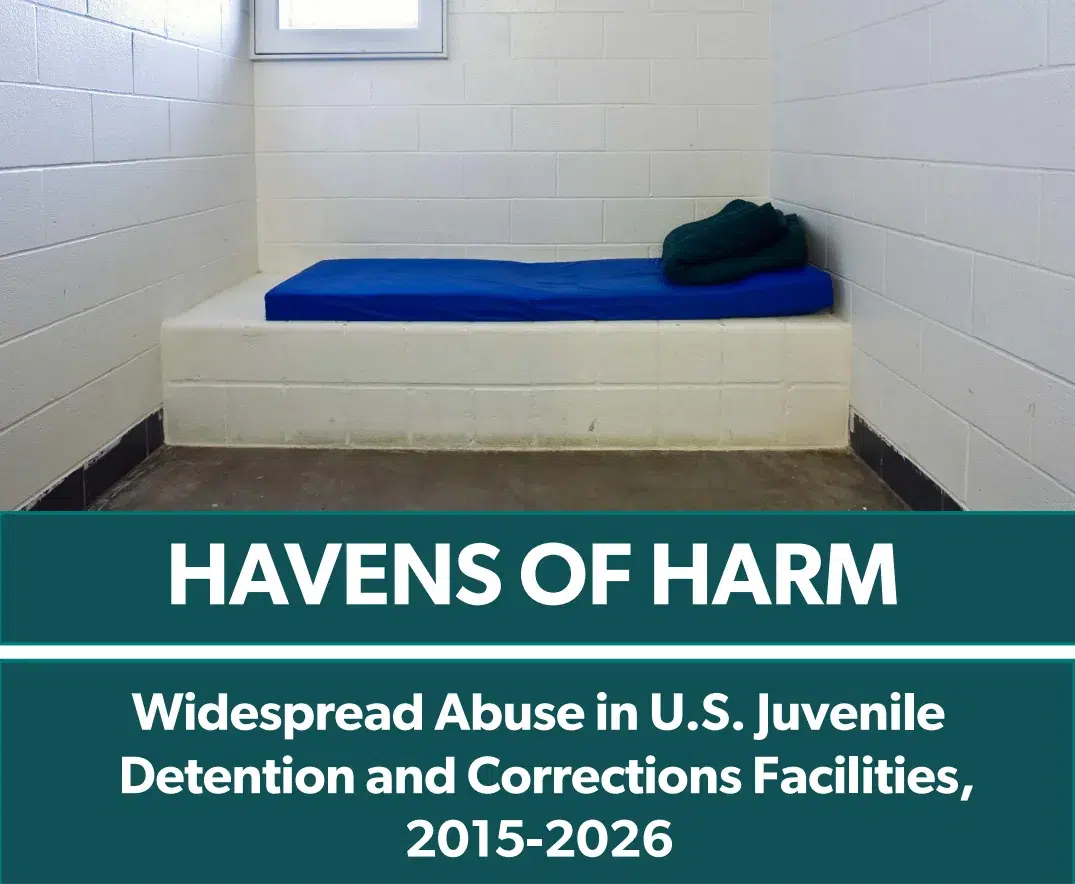
Image: Cover of Havens of Harm: Widespread Abuse in U.S. Juvenile Detention and Corrections Facilities, 2015–2026. Screenshot from The Sentencing Project (opens in a new tab).
A national investigation has identified widespread sexual abuse, physical violence and dangerous living conditions in juvenile detention centers across the United States, Big News Network reported (opens in a new tab).
The report, released last week by The Sentencing Project (opens in a new tab), a criminal justice research and advocacy organization, found evidence or credible allegations of recurring abuse at 247 juvenile detention and correctional facilities in 41 states and Washington, D.C.
Sexual abuse was identified at 80 of those facilities.
And researchers believe the actual scope of the problem is considerably larger.
The report, titled Havens of Harm: Widespread Abuse in U.S. Juvenile Detention and Corrections Facilities, 2015–2026, examined lawsuits, government investigations, news reports and other documentation covering more than a decade.
Sexual Abuse Allegations Involve Staff Members and Other Residents
According to the report, sexual abuse at juvenile detention facilities frequently involved staff members who used their positions of authority to exploit children in custody.
Some employees allegedly groomed young residents by offering gifts, special privileges, attention or access to prohibited items.
Others used intimidation or threats to discourage children from reporting misconduct.
The report also documented incidents involving sexual assaults by other detained youth, sometimes under circumstances where staff members allegedly failed to intervene.
One particularly disturbing example comes from the Tulsa County Family Center for Juvenile Justice in Oklahoma.
There, 21 young people reported being sexually abused by three staff members during 2023 and 2024.
In Oregon, employees at juvenile correctional facilities faced allegations of grooming and sexually exploiting teenagers under their supervision.
The common thread is the imbalance of power between children in custody and the adults responsible for supervising them.
Unlike children attending ordinary schools, detained teenagers cannot simply leave an unsafe environment. They rely on facility employees for protection, meals, medical care and communication with the outside world.
That dependence can make reporting abuse especially difficult.
Nearly 250 Facilities Identified Across 41 States
The report examined six categories of mistreatment, ranging from sexual abuse to excessive restraints and prolonged isolation.
Its findings included:
- 80 facilities: Sexual abuse involving staff members or other confined youth.
- 84 facilities: Physical abuse by staff.
- 79 facilities: Violence involving other youth.
- 131 facilities: Abusive use of solitary confinement.
- 71 facilities: Dangerous or excessive use of physical restraints.
- 75 facilities: Other seriously unsafe or inhumane conditions.
These categories overlap. A single institution could appear in multiple categories if researchers identified different forms of mistreatment.
Researchers generally required credible documentation of repeated incidents, abusive institutional practices or other qualifying circumstances.
Even with those restrictions, they identified 247 facilities where abuse had occurred or was credibly alleged between 2015 and mid-2026.
The report also documented at least 27 deaths of young people in custody during that period, including 12 suicides.
Those deaths were not all connected to sexual abuse. Rather, they illustrate the broader safety failures researchers uncovered.
Juvenile Detention Sexual Abuse Lawsuits Are Growing Across the Country
The findings come amid a wave of civil lawsuits involving former residents of juvenile detention centers.
Many survivors allege that guards, counselors and other employees sexually abused them while administrators ignored complaints, failed to supervise staff or allowed misconduct to continue.
In several states, changes to childhood sexual abuse filing deadlines have enabled former residents to pursue lawsuits decades after leaving detention.
The Sentencing Project highlighted the extraordinary scale of litigation in several jurisdictions.
In Los Angeles County, approximately 6,800 former juvenile facility residents had joined sexual abuse claims, according to figures cited in the report.
Other examples included more than 900 plaintiffs in Illinois, approximately 650 in Maryland, more than 360 in Washington state and roughly 250 cases in New Jersey.
Those figures reflect the litigation counts available to the researchers, not necessarily the number of lawsuits currently pending in November 2026.
New Hampshire’s Juvenile Abuse Scandal Is Part of a Larger Pattern
New Hampshire provides another example of how longstanding abuse allegations can develop into extensive litigation.
Hundreds of former residents of the state’s Youth Development Center, later renamed Sununu Youth Services Center, have accused staff members of sexual abuse and other misconduct.
The state has resolved hundreds of claims through its compensation program, while additional lawsuits and investigations remain active.
A 2026 report from New Hampshire’s Office of the Child Advocate also raised concerns about ongoing conditions at the Sununu facility, including allegations of excessive physical force.
State officials disputed those findings.
The Sentencing Project identified sexual abuse at three New Hampshire juvenile facilities and excessive solitary confinement at nine locations.
These findings suggest that the problems uncovered in New Hampshire are not unique to that state.
Similar allegations have emerged at juvenile institutions across the country, sometimes involving facilities that had already faced investigations or warnings about unsafe conditions.
Why Does Abuse Continue Inside Juvenile Facilities?
The researchers identified several recurring factors.
One is isolation.
Juvenile detention centers are often closed institutions where children have limited contact with parents, independent advocates or attorneys.
Many are located far from the communities where detained children live.
That makes outside scrutiny difficult and can allow misconduct to go undetected.
Staffing problems are another concern.
According to research cited by The Sentencing Project, 90% of juvenile correctional agencies reported difficulties hiring and retaining frontline employees.
Understaffing can contribute to poor supervision, dangerous interactions among residents and inadequate responses to abuse complaints.
But the researchers argue that hiring more staff alone will not solve the problem.
They contend that juvenile detention systems have repeatedly failed to prevent mistreatment, even after investigations, lawsuits and promises of reform.
The report also criticizes excessive reliance on incarceration for children who could potentially be supervised through community-based programs.
Researchers Call for Independent Oversight and Less Youth Incarceration
The Sentencing Project recommends major changes to how juvenile justice systems operate.
Among its proposals are reducing the number of children placed in detention, prohibiting abusive disciplinary practices and expanding independent oversight.
The researchers also recommend stronger reporting systems that allow children to disclose mistreatment without fear of retaliation.
Other recommendations include greater transparency about facility conditions, restrictions on solitary confinement and excessive restraints, and improved surveillance in areas where abuse could otherwise go undetected.
Those proposals reflect the organization’s longstanding position that youth incarceration should be used sparingly.
The report does not establish that every juvenile detention facility is abusive, nor does it independently verify every allegation described in the underlying lawsuits.
But its findings challenge the idea that abuse in juvenile institutions can be dismissed as isolated misconduct by a handful of employees.
For the thousands of former juvenile facility residents now pursuing civil lawsuits, the research provides additional context for allegations that institutions failed to protect children entrusted to their care.