Skip to content
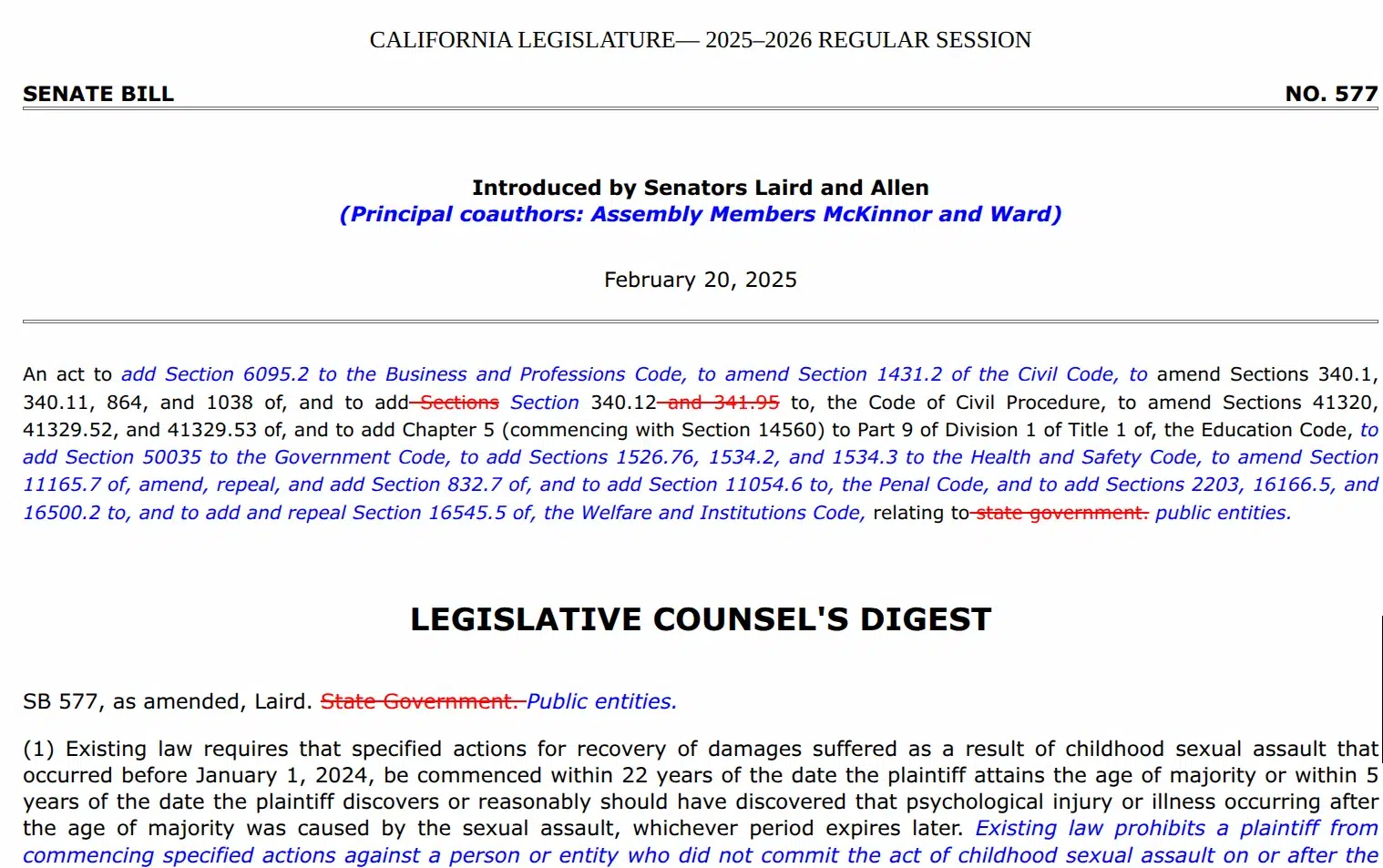
Image: California Senate Bill 577 legislative text, screenshot via LegiScan.
A closely watched California bill that could change how some survivors of childhood sexual abuse pursue claims against public schools, counties and other government entities is headed to Gov. Gavin Newsom, Cal Matters reported.
The Legislature approved Senate Bill 577 yesterday after years of debate over how to balance survivors’ right to seek compensation with growing financial pressure on school districts and local governments.
For survivors, the final bill is a mixed result.
Perhaps the biggest thing that is not in SB 577 is a cap on damages.
Schools and local governments had pushed for limits on how much survivors could recover, arguing that settlements, jury awards and rising insurance costs are draining public budgets. Survivor advocates strongly opposed the idea, arguing that lawmakers should not place an arbitrary dollar value on the harm caused by childhood sexual abuse.
The Legislature ultimately rejected those caps.
But the compromise comes with provisions that could make some older claims much more difficult to prove.
Survivors Over 40 Could Face a Higher Standard
Under the version of SB 577 sent to Newsom, certain survivors who are 40 or older when they file a lawsuit against a public entity would have to meet a “clear and convincing evidence” standard.
That is a higher burden than the ordinary civil standard of proving something is more likely than not.
For covered claims involving childhood sexual abuse that occurred before Jan. 1, 2024, a survivor would have to establish by clear and convincing evidence that the public entity knew of misconduct that resulted in childhood sexual assault and failed to take reasonable precautions or safeguards.
The survivor would also have to prove that the public entity negligently failed to carry out a mandatory duty. The heightened burden applies to qualifying lawsuits against public entities filed on or after Jan. 1, 2026, although it would not apply where a judgment has already been entered or the case is subject to a final settlement.
Childhood sexual abuse cases often surface decades after the abuse occurred. By then, records may be missing, witnesses may have died or become difficult to locate, employees may have left the institution and evidence showing exactly what administrators knew may no longer exist.
That is precisely why some survivor advocates believe the new standard could shut the courthouse door on people who otherwise have credible claims.
California’s laws governing childhood sexual abuse claims have changed repeatedly in recent years, and the filing rules can depend on when the abuse occurred, your age and who may be legally responsible.
Learn more about your options in our California Sexual Abuse Lawsuit Guide.
Why Survivor Advocates Are Worried
One of the central objections to SB 577 is the requirement that an older survivor prove what the institution itself knew.
A survivor may know what happened to them, and they may have evidence identifying the person who abused them or may even be able to show that other children were abused by the same individual.
But proving decades later that a school district, county or other public entity knew of the misconduct at the time can be an entirely different challenge.
Stand With Survivors co-founder Caroline Heldman called the bill harmful to survivors and argued that the new evidentiary threshold could become nearly impossible for some people who wait until later in life to come forward.
That concern was echoed on the Senate floor. Sen. Shannon Grove opposed the measure in part because of the combination of the clear-and-convincing standard and the requirement to prove institutional knowledge.
The issue is particularly significant because delayed disclosure of childhood sexual abuse is not unusual. A person may need several years before they are prepared to talk about what happened, much less pursue a lawsuit.
The passage of time doesn’t necessarily make the abuse less real. It can, however, make the documentary evidence much harder to find.
SB 577 Also Changes Filing Rules for Older Abuse
SB 577 would also revise the deadline for claims involving childhood sexual assault that occurred before Jan. 1, 2024.
For those older cases, the legislation provides a deadline of 22 years after the survivor turns 18—effectively age 40—or three years after the survivor discovers or reasonably should have discovered that an adult psychological injury or illness was caused by the childhood sexual abuse, whichever is later.
California has changed its childhood sexual abuse laws repeatedly in recent years.
AB 218, signed in 2019, expanded the filing period and created a three-year revival window for many previously expired claims. AB 452 later eliminated the civil statute of limitations for childhood sexual assault occurring on or after Jan. 1, 2024.
SB 577 does not eliminate that no-deadline rule for abuse occurring from 2024 forward. Instead, many of its most controversial provisions concern older abuse and claims against public entities.
How California’s Childhood Sexual Abuse Laws Have Changed
| California Law | What It Did | Why It Matters to Survivors |
|---|---|---|
| AB 218 Signed in 2019 | Expanded California’s statute of limitations for childhood sexual abuse claims and created a three-year revival window for many claims that had previously expired. | Allowed many adult survivors to pursue lawsuits that previously would have been barred because too much time had passed. The revival window ran through Dec. 31, 2022. |
| AB 452 Effective Jan. 1, 2024 | Eliminated the civil statute of limitations for childhood sexual assault occurring on or after Jan. 1, 2024. | Survivors of abuse occurring from 2024 forward are no longer subject to a civil filing deadline based solely on the passage of time. The law is not retroactive to older abuse. |
| SB 577 Passed Legislature in 2026 | Would impose a higher “clear and convincing evidence” standard on certain older childhood sexual abuse claims against public entities while leaving damages uncapped and adding new abuse-prevention requirements. | Could make some claims by survivors age 40 and older more difficult to prove, particularly when decades-old records or evidence of what a school or government agency knew are missing. |
Schools and Counties Say the Current System Is Unsustainable
The other side of the debate is the extraordinary financial exposure now facing California public entities.
Thousands of lawsuits have been filed since lawmakers expanded survivors’ ability to bring older claims.
Los Angeles County alone approved a $4 billion settlement involving nearly 7,000 childhood sexual abuse claims connected primarily to juvenile detention and foster care facilities.
School districts have also reported spending down reserves, borrowing money and cutting programs while facing abuse claims and sharply higher insurance costs.
Supporters of SB 577 describe the bill as an attempt to prevent those financial pressures from threatening schools and other public services without stripping survivors of their right to sue.
That compromise is one reason lawmakers refused to go as far as public agencies wanted.
There are no damages caps in the final bill.
SB 577 Includes New Abuse-Prevention Requirements
The legislation does more than change lawsuits.
By Dec. 1, 2027, local governments and educational agencies would be required to adopt codes of conduct, sexual abuse prevention plans and procedures for reporting grooming and suspected abuse.
Those rules would address issues such as appropriate boundaries between adults and minors and communications through social media, text messages and other channels.
Local governmental bodies would also be required to provide their policies to the California Attorney General, with the state ultimately reporting on whether agencies complied.
Newsom Now Has the Final Say
SB 577 passed the Assembly 46-19 and the Senate 24-10 before being sent to Gov. Newsom.
He has until Sept. 30 to sign or veto the legislation.
Some survivor organizations are urging him to reject it.
Others have accepted the legislation as an imperfect compromise, particularly because lawmakers rejected damages caps and included stronger abuse-prevention requirements.
That tension says a lot about where California stands right now.
The state has spent years expanding survivors’ ability to seek justice for abuse that happened long ago. At the same time, lawmakers are now confronting the enormous financial consequences of institutional abuse that went unaddressed for decades.
Those financial realities are legitimate public-policy concerns. But survivors didn’t create them.
When a school, county or other institution failed to protect a child, the cost of that failure did not suddenly appear when the survivor filed a lawsuit years later. The harm had already occurred.
The difficult question raised by SB 577 is who should bear the consequences now, and whether making older survivors prove substantially more than other civil plaintiffs is a fair way to resolve that problem.