Skip to content

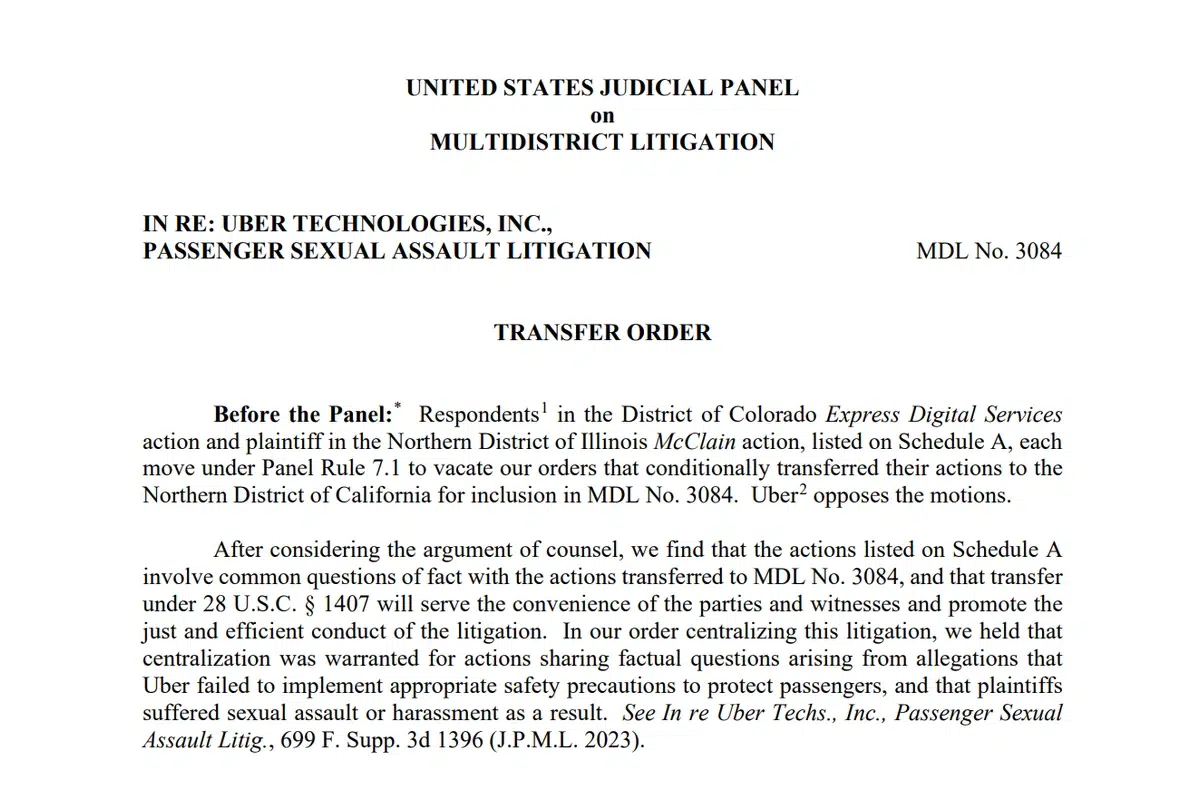
Image: screenshot of a federal transfer order in Uber passenger sexual assault litigation (MDL 3084). Source: U.S. Judicial Panel on Multidistrict Litigation (opens in a new tab) (JPML).
After three years of coordinating thousands of sexual assault lawsuits against Uber, a federal judge says it’s time to start moving some of those cases out of the consolidated litigation and back toward individual trials.
U.S. District Judge Charles Breyer, who oversees the Uber passenger sexual assault multidistrict litigation in San Francisco, announced during a November 16 hearing that he intends to begin winding down his involvement in the proceedings.
According to Bloomberg Law (opens in a new tab), Breyer plans to return some lawsuits to the federal courts where they were originally filed, allowing those cases to proceed toward trial.
As of November 2, 2026, the federal litigation included 4,548 pending lawsuits, according to the Judicial Panel on Multidistrict Litigation (JPML).
Why Is the Judge Preparing to Wind Down the Uber Litigation?
The federal lawsuits are part of multidistrict litigation, or MDL 3084, which was established in October 2023.
An MDL brings similar lawsuits from different federal courts before one judge to streamline the legal process.
Instead of having dozens of judges separately handle disputes over evidence, corporate records and pretrial motions, one court coordinates much of that work.
In Uber’s case, the lawsuits generally accuse the rideshare company of failing to adequately protect passengers from sexual assault and other misconduct by its drivers.
The consolidated proceedings have allowed the parties to examine Uber’s driver-screening practices, passenger safety measures and handling of sexual misconduct complaints.
But MDLs aren’t necessarily intended to keep every lawsuit in one courtroom indefinitely.
Once enough pretrial work has been completed, cases that haven’t settled may be sent back to their original federal courts for trial.
That’s the process Breyer now appears ready to begin, with Bloomberg Law reporting that Judge Breyer has indicated that he wants to prioritize cases involving particularly serious allegations.
The timing and number of cases that could be returned have not yet been established in the publicly available reporting.
Judge Previously Pressed Uber to Consider Broader Settlements
Breyer’s announcement follows months of growing frustration over the pace of the litigation.
During a September hearing, Judge Breyer urged Uber to reconsider its approach to resolving the lawsuits rather than continuing to fight or settle individual claims without a broader resolution.
At the time, thousands of cases remained pending, and more were continuing to enter the federal litigation.
Breyer encouraged discussions that could potentially lead to a more comprehensive settlement.
But no nationwide settlement resolving all Uber sexual assault claims has been announced.
The possibility of returning cases to their original courts introduces another way forward; if the parties cannot reach settlements, individual lawsuits can proceed toward trial.
That could mean more courtrooms, more juries and potentially more verdicts involving Uber’s responsibility for passenger safety.
Uber Sexual Assault Lawsuits: Settlements, Verdicts and Legal Options
Thousands of passengers have filed lawsuits accusing Uber of failing to protect riders from sexual assault. The federal litigation has already produced major jury verdicts, individual settlements and ongoing disputes over Uber’s responsibility for driver misconduct.
Learn about the latest MDL developments, potential settlement outcomes, and what survivors should know about pursuing a claim.
Earlier Uber Sexual Assault Trials Produced Very Different Verdicts
The federal litigation has already produced two closely watched bellwether verdicts.
Bellwether trials are test cases selected to help the parties evaluate how juries respond to evidence and arguments that may arise in other lawsuits.
In February 2026, an Arizona jury awarded $8.5 million to a woman who said she was raped by an Uber driver. Jurors found Uber liable under a legal theory involving the driver’s apparent authority to act on the company’s behalf.
Two months later, a North Carolina jury reached a much smaller verdict.
In April, jurors awarded $5,000 to a woman who accused her Uber driver of sexual inpropriety during a 2019 trip. The jury found that the driver committed battery, but did not find that sexual assault occurred.
Uber was nevertheless held responsible under a common-carrier theory recognized by the trial judge.
The third scheduled federal bellwether trial, involving a Texas passenger, never reached opening statements. Uber settled that case in October for an undisclosed amount.
Those results demonstrate why individual trials remain important. Even when lawsuits involve similar accusations against Uber, the facts, applicable state laws and damages can produce very different outcomes.
North Carolina AG Backs Passenger in Uber Appeal
The same day Breyer announced his plans for the federal litigation, North Carolina Attorney General Jeff Jackson announced (opens in a new tab) that his office had entered the legal fight over the April bellwether verdict.
Jackson filed a friend-of-the-court brief urging the Fourth Circuit Court of Appeals to uphold the $5,000 verdict against Uber.
The dispute centers on whether Uber should be treated as a common carrier under North Carolina law, similar to a taxi or bus company, and therefore held responsible when drivers intentionally harm passengers.
Uber has challenged that interpretation, arguing that it should not be liable for the intentional misconduct of independent drivers.
Jackson contends that rideshare companies should not escape passenger-safety responsibilities simply because they use an app to connect riders with drivers.
The appeals court’s decision could help clarify how North Carolina law applies to similar lawsuits, although it would not automatically determine the outcome of claims filed under other states’ laws.
What Happens Next for Uber Sexual Assault Survivors?
The biggest takeaway from Breyer’s announcement is that the litigation could be entering a new phase.
Rather than concentrating thousands of lawsuits before one judge in San Francisco, some cases may begin moving back to federal courts around the country.
For survivors whose cases are returned, the next steps could involve additional court proceedings, settlement negotiations or individual trials.
That doesn’t mean every case will go before a jury. Some may settle, while others may face additional legal challenges.
And a judge’s decision to begin winding down an MDL doesn’t mean the underlying lawsuits disappear.
For survivors still considering legal action, another important distinction remains the timing of the MDL’s wind-down does not determine the filing deadline for an individual sexual assault claim. Those deadlines depend on the applicable law and circumstances.
Whether Breyer’s latest announcement encourages broader settlement talks or leads to more trials remains to be seen.
But after three years of centralized litigation, thousands of Uber sexual assault lawsuits may be moving toward a different stage of the legal process.