Skip to content
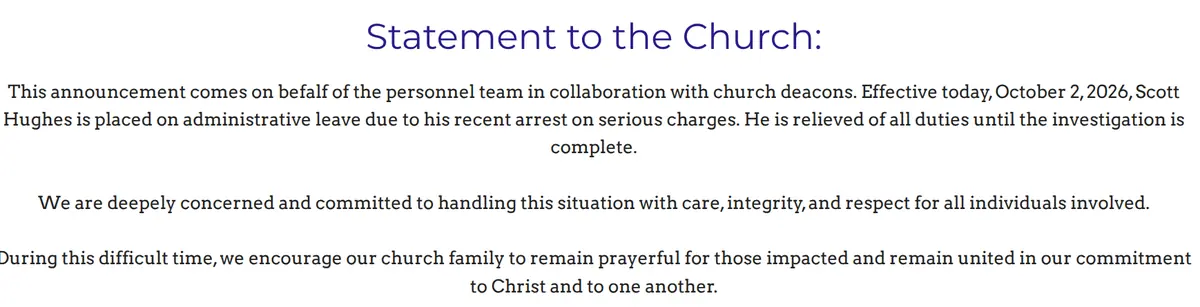
Image: Screenshot from Pleasant View Baptist Church website statement regarding Scott Hughes. Used for editorial reporting and commentary.
The arrest of Kentucky pastor Scott C. Hughes on sexual abuse charges prompted longtime evangelical educator and former ministry worker Kevin Maples to ask in an article published at ForwardKy.com (via BishopAccountability.com) if some church structures make it easier for sexual misconduct to go undetected or unchecked.
Maples argues that the problem is not necessarily that churches intentionally protect offenders. Instead, he points to structural features common in some evangelical congregations that he believes can weaken safeguards around children and other vulnerable people.
Maples draws on decades spent in evangelical churches and Christian organizations, including Southern Baptist settings. He focuses on three areas: inconsistent requirements for pastors, limited accountability outside individual congregations and male-dominated leadership structures.
Few Standardized Requirements for Pastors
Maples argues that many Southern Baptist and similar churches give substantial authority to pastors without requiring a standardized educational, licensing or denomination-wide vetting process.
In his experience, smaller congregations may choose pastors based largely on reputation, personal appeal and preaching ability. The local church decides what qualifications are necessary.
Maples contrasts that system with denominations that require clergy to complete formal education, ordination processes, continuing training or review by regional or national governing bodies.
His concern is that when hiring standards vary widely from one congregation to another, there may be fewer safeguards for identifying candidates who are poorly prepared for leadership or who raise other concerns.
Local Church Autonomy Can Limit Accountability
Maples’ second concern is what happens after a pastor is hired.
Southern Baptist churches are locally autonomous, meaning individual congregations have significant control over hiring, discipline and other internal decisions.
Maples argues that this can create gaps in accountability when a pastor leaves one congregation and seeks work at another.
If a pastor is dismissed for serious misconduct, he writes, there may be no centralized system requiring that information to follow him to his next church.
Maples says he has seen pastors move from congregation to congregation despite conduct he believed should have prompted greater scrutiny.
In sexual abuse cases, that type of information-sharing can become critical. Lawsuits and investigations involving churches frequently examine whether leaders knew about earlier complaints, whether misconduct was documented and whether another congregation was warned before an accused person gained access to children again.
Male-Dominated Leadership Structures
Maples also focuses on complementarian theology, a belief held by many conservative evangelical churches that men and women have equal value but different roles within the church and family.
In many complementarian congregations, pastoral and governing leadership positions are reserved for men, while husbands are viewed as having a leadership role within the family.
Maples argues that those structures can reinforce unequal power relationships and make it more difficult for women or others with less institutional authority to challenge respected male leaders.
He contrasts that approach with egalitarian Christian traditions, which allow men and women to serve in the same leadership positions.
Maples does not simply argue that a particular theology causes sexual abuse. His broader point is that combining concentrated authority, limited outside oversight and cultural expectations about who should lead can weaken checks on misconduct.
Do Churches Have Enough Guardrails?
Maples’ argument ultimately comes down to institutional safeguards.
Who screens people before they become pastors? Who receives complaints about them? Can someone outside the local congregation independently investigate allegations? Is misconduct documented when a pastor leaves? And will another church be told why that person was removed?
Those questions extend well beyond one denomination.
Sexual abuse lawsuits involving churches often focus on whether leaders recognized warning signs, responded to previous complaints, reported suspected abuse and took reasonable steps to keep accused individuals away from children.
Maples argues that churches with highly decentralized authority should examine whether local autonomy has created gaps that allow misconduct to go unaddressed.
The issue is not simply whether a church has written policies. It is whether those policies create meaningful accountability when allegations involve someone with authority, trust and access to children.