Skip to content
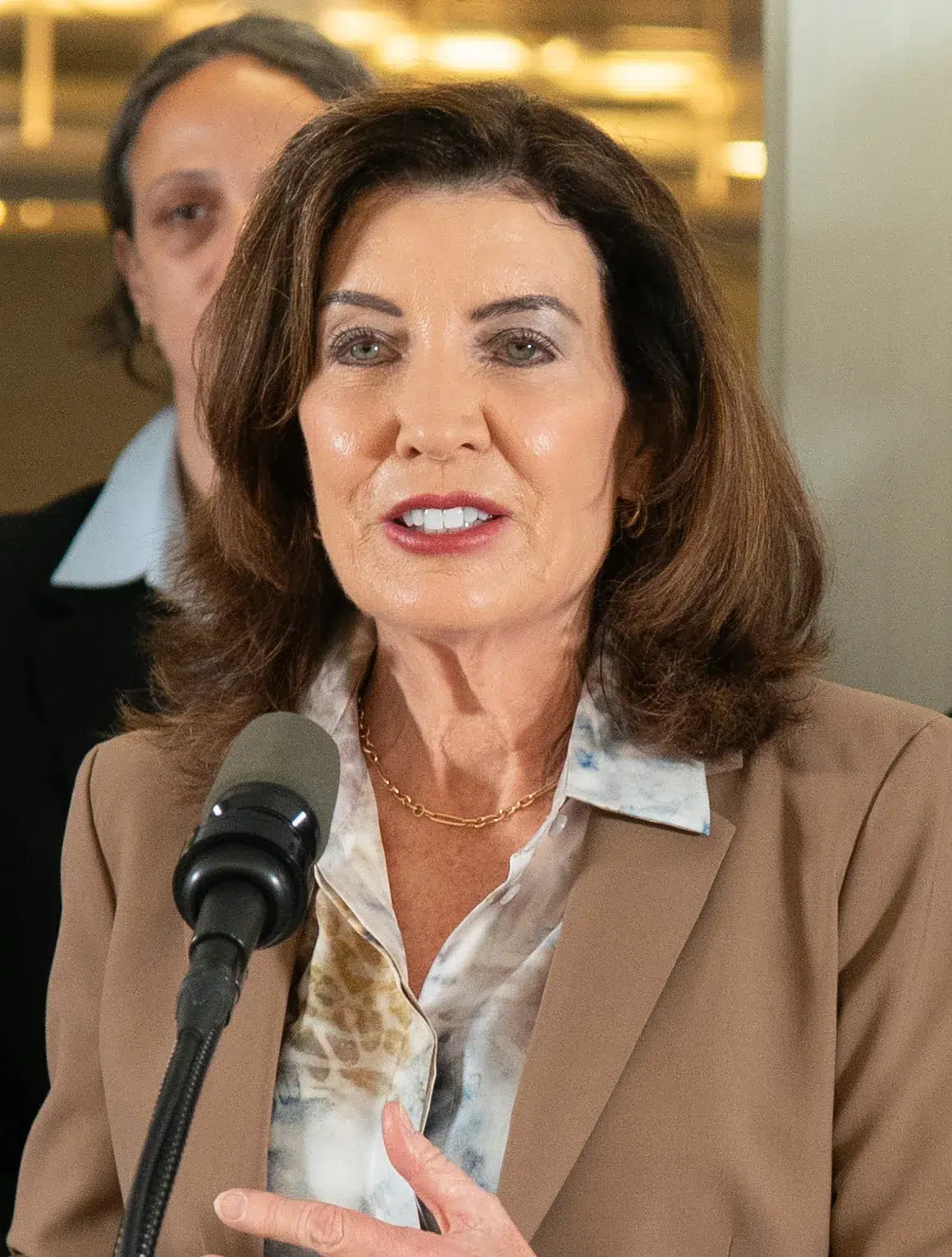
Photo: New York Gov. Kathy Hochul by Metropolitan Transportation Authority, Flickr, CC BY 4.0, via Wikimedia Commons.
The sexual assault allegations involving seven former Cornell University fraternity members have become much more than a dispute over what happened inside a fraternity house in October 2024.
They’re now forcing New York to examine the legal question of when someone voluntarily becomes severely intoxicated, at what point are they no longer capable of consenting to sex?
The question sounds straightforward, however, legally, it’s anything but…
A former Cornell student identified as Jane Doe alleges that members of the Chi Phi fraternity sexually assaulted her after she consumed alcohol, marijuana and ketamine. Seven men are named in the civil lawsuit.
The men have disputed allegations against them, and none had been criminally charged when the controversy erupted again in September.
What makes the case especially complicated is that the student acknowledged voluntarily consuming intoxicants that night. The Tompkins County District Attorney’s Office initially concluded that the account it received didn’t establish a crime under New York law.
That decision has since come under intense scrutiny.
New York Gov. Kathy Hochul removed the local district attorney from the criminal investigation and appointed Attorney General Letitia James as special prosecutor. Questions have also emerged about whether prosecutors received or reviewed the full body of evidence gathered by Cornell police. ABC News reported that the district attorney’s office initially reviewed a six-page summary of the student’s statement but declined an offer to examine additional interviews collected by campus investigators.
At the same time, lawmakers are again pushing legislation that would change how New York treats voluntary intoxication in sexual assault cases.
The Cornell controversy has exposed a difficult intersection of personal responsibility, sexual autonomy and criminal law.
What New York Law Currently Says
Under New York law, lack of consent can be established in several ways, including forcible compulsion, incapacity to consent and, for certain offenses, circumstances in which a person clearly expresses that they don’t consent.
The complication involves intoxication.
New York defines someone as “mentally incapacitated” when the person temporarily cannot understand or control their conduct because of an intoxicating substance that was administered without their consent, or because of another act committed against them without consent.
Someone who is secretly drugged may qualify as mentally incapacitated under that provision.
However, someone who voluntarily drinks alcohol or takes a drug and later becomes severely impaired may not qualify under the same provision simply because of the intoxication.
That doesn’t mean voluntarily consuming alcohol or drugs automatically constitutes consent to sex. Other provisions of New York law may still apply, including forcible compulsion, clearly expressed nonconsent or physical helplessness.
But the distinction can make certain cases considerably more difficult to prosecute.
The Cornell case has brought that problem into sharp focus.
The local district attorney said the statement originally provided to prosecutors didn’t allege that Jane Doe had been involuntarily intoxicated, physically forced, unconscious or that she had clearly communicated nonconsent in a manner that satisfied the applicable criminal statutes.
That was the legal basis for declining charges at the time.
However, subsequent reporting indicates that prosecutors may not have reviewed everything Cornell police had gathered before deciding against prosecution.
ABC News reported that campus investigators had conducted additional interviews and pursued other information but that prosecutors indicated they did not intend to review those materials after examining Jane Doe’s statement.
Other reporting has also raised questions about statements Jane Doe made during the original investigation that may not have been included in the condensed account prosecutors reviewed.
Those revelations don’t establish that a rape occurred, but they complicate the argument that the original prosecutorial decision definitively settled the question.
They also help explain why the case is now receiving another criminal review.
Voluntarily Taking Drugs Is a Choice. Consent Is Another Choice.
The debate surrounding the case can become polarized quickly.
One side focuses primarily on Jane Doe’s intoxication and asks why someone who voluntarily drank heavily or used ketamine shouldn’t bear responsibility for the consequences of those decisions.
The other side argues that even raising those choices amounts to blaming someone for being sexually assaulted.
Neither framing captures the entire issue. For example, there’s the matter of personal choices having consequences.
Drinking heavily, using recreational drugs or entering situations while impaired can affect judgment, memory and personal safety. Pretending otherwise does young adults no favors in helping them understand those inherent risks.
But voluntarily accepting one risk does not mean accepting every possible consequence.
Choosing to become intoxicated is not the same decision as consenting to sexual activity.
Likewise, agreeing to one sexual act doesn’t establish consent to another. Agreeing to sex with one person doesn’t automatically establish consent to sex with additional people. And consent given initially can later be withdrawn.
Those distinctions are already incorporated into New York’s affirmative-consent rules for colleges.
State education law requires colleges to recognize that prior sexual activity doesn’t necessarily constitute consent to another act, that consent can be withdrawn and that, depending on the degree of intoxication, a person under the influence of drugs or alcohol may become incapacitated and unable to consent.
That creates an unusual divide.
Conduct may violate a university’s sexual misconduct rules even when prosecutors believe the evidence doesn’t satisfy New York’s criminal statutes.
Lawmakers Want to Change the Criminal Standard
State Sen. Nathalia Fernandez and Assemblymember Jeffrey Dinowitz have pushed legislation that would expand the circumstances in which voluntary intoxication can establish an inability to consent.
Under the proposal, the central issue would not simply be whether someone chose to consume alcohol or drugs.
Instead, prosecutors could pursue charges when a person became so intoxicated that they were incapable of consenting and the accused knew or reasonably should have known about that incapacity.
The proposal has significant bipartisan support.
A version passed the New York Senate unanimously but has remained stalled in the Assembly.
Supporters argue that the existing distinction makes little sense.
A person who is incapable of understanding or controlling what is happening, they argue, doesn’t suddenly regain the ability to consent simply because they voluntarily consumed the substance that caused the impairment.
There is also another side worth considering.
Expanding criminal liability raises questions about how juries determine exactly when ordinary intoxication becomes legal incapacity, particularly when two or more people involved may all have been drinking or using drugs.
Criminal cases require proof beyond a reasonable doubt.
A law must therefore distinguish between someone who is impaired but still making decisions and someone whose impairment has become so severe that meaningful consent is no longer possible.
The pending legislation attempts to address that concern through a reasonable-person standard: whether the accused knew or should have known the other person was incapable of consent.
Whether that standard strikes the right balance is now part of the debate.
New York’s sexual abuse and assault laws can be complex, especially when consent, intoxication, or filing deadlines are involved.
Learn more in our New York Sexual Abuse Attorney Guide.
Consent Cases Don’t Always Fit Into Easy Categories
The Cornell case is divisive partly because it resists the simple narratives people often want.
A person can make a poor decision about drugs or alcohol without consenting to be sexually assaulted; someone can voluntarily participate in some sexual activity without agreeing to everything that follows.
People accused of disturbing or degrading behavior can nevertheless be entitled to a criminal justice system that requires the government to prove every element of an offense.
And a prosecutor can reasonably conclude that an existing statute prevents charges while lawmakers reasonably conclude that the statute itself should be changed.
Those ideas aren’t mutually exclusive.
For now, what happened inside the Chi Phi fraternity house remains disputed. A renewed criminal investigation may produce additional evidence, and any charging decision will have to be based on the law and facts rather than public outrage in either direction.
But even after the Cornell investigation ends, the central question will remain: Should a person’s legal ability to consent depend on who put the intoxicant into their body?
New York lawmakers increasingly appear to believe the answer should be no.
The harder task is writing a law that protects people who have become genuinely incapable of consent while preserving the evidentiary standards and due-process protections that criminal cases require.
Related News Coverage:
How Police Question Sexual Assault Survivors: Cornell Case Raises Broader Questions
DA Reopens Cornell Fraternity Sexual Assault Investigation, Plans Grand Jury Review
Cornell, Fraternity and Sorority Groups Sued Over Alleged 2024 Sexual Assault
References:
New York State Senate, Penal Law § 130.00 — Sex Offenses; Definitions of Terms.
New York State Senate, Penal Law § 130.05 — Sex Offenses; Lack of Consent.
New York State Senate, Education Law § 6441 — Affirmative Consent to Sexual Activity.
Reuters, Alleged Cornell Gang Rape Prompts Calls to Revise New York Sexual Assault Laws, Oct. 1, 2026.
Reuters, What We Know About the Cornell University Rape Investigation, Oct. 1, 2026.
Reuters, New York Attorney General Named Special Prosecutor in Cornell Rape Probe, Oct. 2, 2026.
Reuters, Cornell Hires Former Justice Department Official Sally Yates to Review Response to Rape Claims, Oct. 6, 2026.