Skip to content
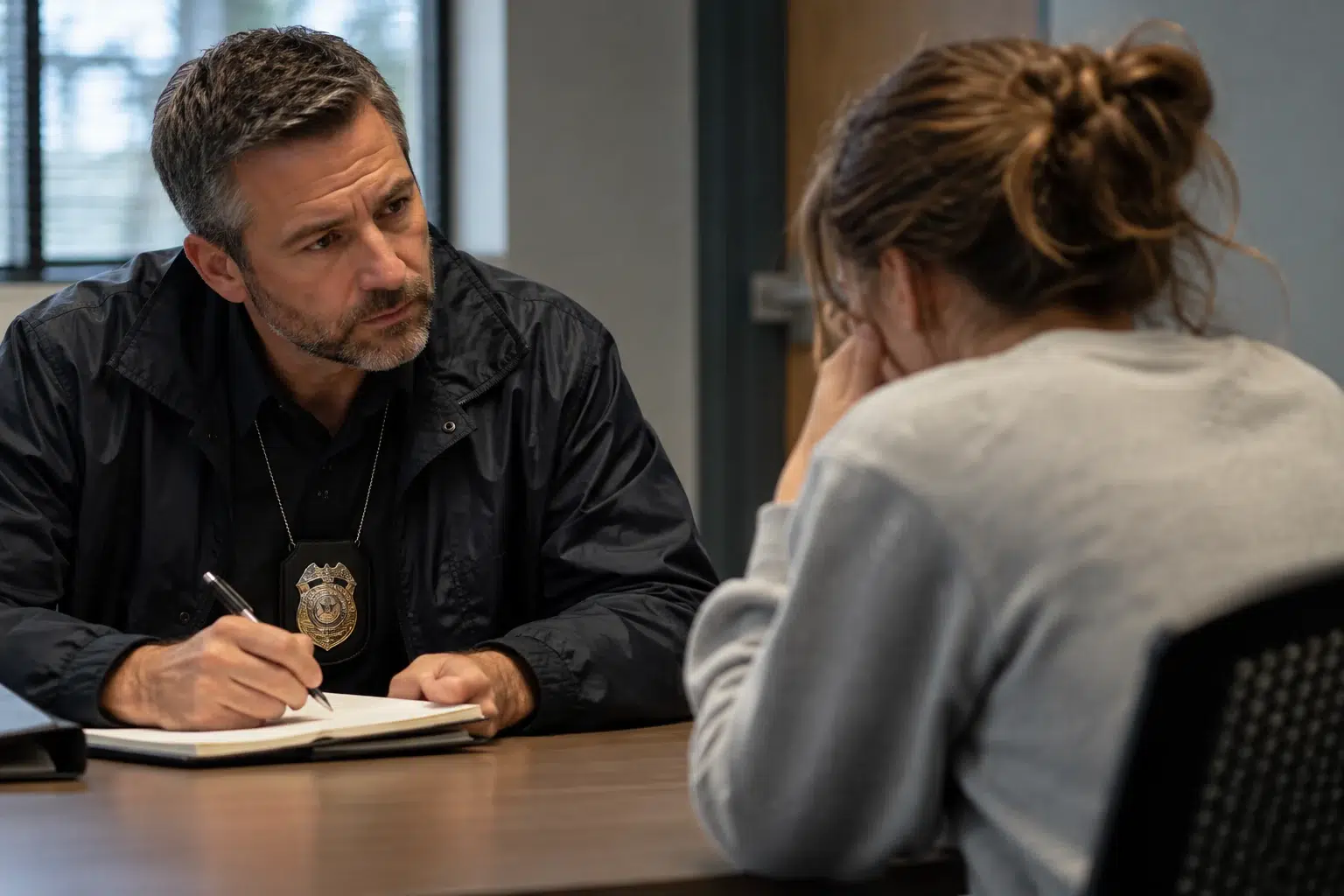
The reopening of a sexual assault investigation involving Cornell University students is drawing attention to how police interview people who report sexual assault.
A former Cornell student identified as Jane Doe says she was drugged and sexually assaulted by multiple men at the Chi Phi fraternity house in 2024. She filed a civil lawsuit in September against seven former students and several organizations.
As SurvivorsRights.com previously reported, Tompkins County District Attorney Matthew Van Houten has since reopened the criminal investigation and plans to present the case to a grand jury.
Now, reporting by NPR is examining whether differences between Doe’s initial account to police and the allegations later described in her lawsuit should have been viewed as credibility problems or as possible signs of trauma that required further investigation.
Trauma Can Affect How Survivors Remember an Assault
According to NPR, excerpts from Doe’s 2024 statement became an important factor in prosecutors’ decision not to bring charges at the time.
Van Houten said the statement did not describe Doe as having been drugged against her will or gang raped and characterized portions of her account as describing voluntary drug use and sexual activity.
But the same statement also reportedly included passages in which Doe said she couldn’t remember certain events, hadn’t consented to some activity and became increasingly intoxicated as the night progressed.
Experts interviewed by NPR said those kinds of gaps or inconsistencies aren’t unusual following a traumatic event.
Dave Thompson, a forensic interviewer who trains investigators, explained that traumatic memories don’t necessarily unfold like a continuous recording. Survivors may remember fragments, such as a sound, physical sensation or isolated moment, while struggling to reconstruct events in chronological order.
An investigator who expects a survivor to immediately provide a complete, linear account may interpret missing details as unreliability when trauma may provide another explanation.
Most Police Receive Limited Sexual Assault Training
One of the more striking findings in NPR’s report involves how little training many police recruits receive on sexual assault and victim response.
A Bureau of Justice Statistics study cited by NPR examined training at U.S. law enforcement academies.
Among academies that provided sexual assault training, recruits received an average of just seven hours of instruction on the subject. Academies offering victim-response training devoted an average of about six hours to it.
That comes within a basic police training program averaging 833 hours.
Rebecca Campbell, a Michigan State University psychology professor who has studied sexual assault and trauma for nearly three decades, told NPR that most police officers aren’t trained in trauma-informed interviewing.
Instead, she said, victims can sometimes be approached more like people being interrogated than people reporting a crime.
The distinction can significantly affect what a survivor is willing or able to tell investigators.
What Is Trauma-Informed Interviewing?
Trauma-informed interviewing is designed around an understanding that trauma can affect memory, behavior and a person’s ability to describe an experience immediately after it happens.
Rather than expecting an account to be perfectly chronological and complete, investigators allow survivors time and space to retrieve memories without treating gaps as automatic evidence that the account isn’t credible.
The goal isn’t to assume that every allegation is accurate. Rather, it’s to investigate what happened without using reactions commonly associated with trauma as a reason to prematurely dismiss a report.
Campbell told NPR that inconsistencies should often lead investigators to ask more questions, conduct additional interviews and seek corroborating evidence rather than simply abandoning an investigation.
Digital Evidence May Go Uncollected
Modern sexual assault investigations can also involve evidence that didn’t exist a generation ago.
Text messages, social media posts, location information and other digital records can potentially corroborate — or contradict — parts of someone’s account.
But Campbell told NPR that her research suggests police frequently don’t obtain that evidence.
In sexual assault cases involving people who know each other, she said research indicates investigators fail to collect potentially relevant text or social-media evidence roughly 80% of the time.
Campbell acknowledged that sexual assault investigations can be complicated. But she also said police departments have repeatedly told researchers that staffing and investigative resources aren’t always prioritized for these cases.
Most Reported Rapes Don’t Lead to Convictions
The broader statistics cited in NPR’s reporting illustrate how rarely reported sexual assaults ultimately result in convictions.
From 2021 through 2025, law enforcement agencies documented an average of about 127,800 rape reports each year, according to data cited by RAINN.
FBI crime statistics show police cleared about 26% of reported rape cases during that period. A clearance doesn’t necessarily mean someone was convicted or even prosecuted. It can include cases in which an arrest was made or a suspect died before prosecution.
Another analysis cited by RAINN found that 89% of sexual assault cases reviewed over a 20-year period were classified as “founded,” meaning investigators concluded that a crime likely occurred.
Only about 8% of cases resulted in a conviction.
Those numbers help explain why the way law enforcement responds during the earliest stages of a sexual assault report can be so consequential.
Cornell Investigation Puts Trauma-Informed Policing Under Scrutiny
The experts interviewed by NPR weren’t involved in the Cornell investigation and didn’t offer conclusions about how Cornell University Police handled Doe’s report.
But the case illustrates the questions trauma researchers have been raising for years.
If a survivor can’t initially remember portions of an assault, does that undermine the report?
If details emerge later, are they evidence of an unreliable account or a reason investigators should look more closely?
And when inconsistencies appear, should the investigation stop or expand?
Those questions have become particularly important in the Cornell case because prosecutors initially declined to pursue charges but are now reviewing the matter again after Doe’s civil lawsuit brought additional allegations and evidence to public attention.
The controversy has also continued to develop. Cornell has since said it will bring in outside counsel to independently examine how the university handled the case, according to subsequent NPR reporting.
For survivors, the broader issue extends well beyond Cornell.
Reporting sexual assault can already require describing an intensely traumatic experience to strangers. When investigators aren’t trained to recognize how trauma can affect memory and communication, an incomplete first account can potentially shape an entire case before the investigation has truly begun.