Skip to content
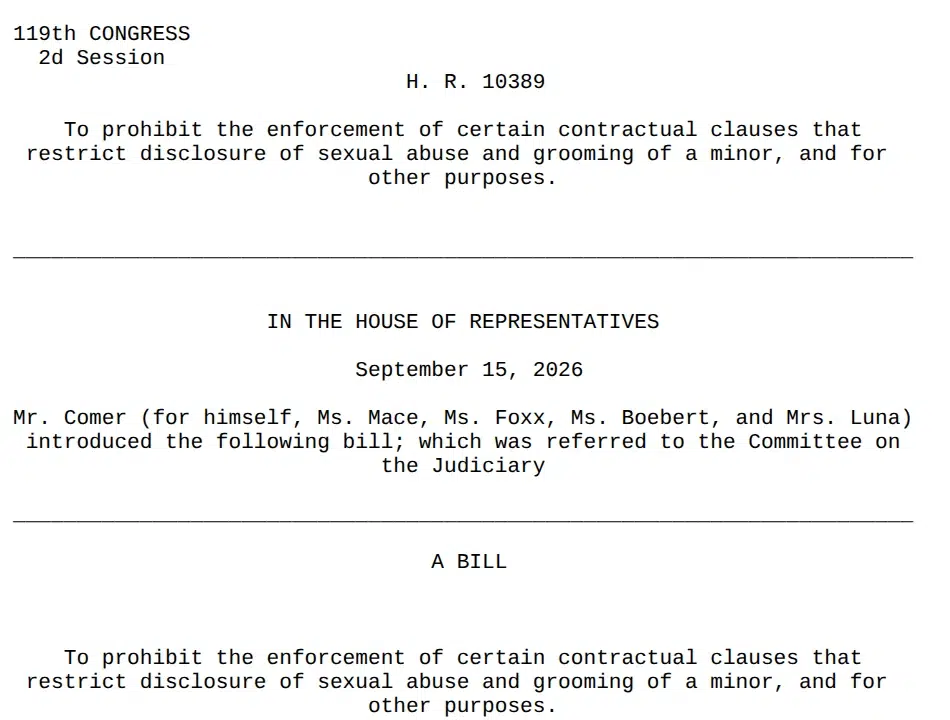
Image: Screenshot of H.R. 10389, the Survivor’s Voice Protection Act, from GovInfo.gov.
A new federal bill would prevent nondisclosure agreements from being used to stop sexual abuse survivors from speaking about what happened to them, including survivors who signed agreements years before the legislation was introduced.
The Survivor’s Voice Protection Act, H.R. 10389, was introduced in the U.S. House on September 15 by Rep. James Comer (R-KY), along with Reps. Nancy Mace (R-SC), Virginia Foxx (R-NC), Lauren Boebert (R-CO) and Anna Paulina Luna (R-FL).
If enacted, the bill would make certain nondisclosure provisions void and unenforceable when they prevent a survivor from disclosing sexual abuse or facts related to the abuse. Importantly, the protection would apply to agreements signed before, on or after the law takes effect.
The legislation has been referred to the House Judiciary Committee and has not yet received a House vote.
Bill Would Apply to Existing Nondisclosure Agreements
Nondisclosure agreements, commonly known as NDAs, are contracts or contractual provisions requiring certain information to remain confidential.
They’re widely used to protect trade secrets, proprietary information and other sensitive business matters. But confidentiality clauses have also appeared in settlements involving sexual abuse, assault and harassment.
For survivors, that can mean receiving compensation through a settlement while agreeing not to publicly discuss some or all of what happened. The Survivor’s Voice Protection Act would limit that practice.
Under the proposed law, an NDA provision would be unenforceable to the extent that it prevents a survivor from disclosing sexual abuse or facts connected to the abuse. The protection would also cover other people making disclosures that support a survivor’s right to speak.
That doesn’t mean every part of a confidential settlement would become public.
The bill specifically allows agreements to keep information such as settlement amounts and payment terms confidential, as long as those restrictions don’t prevent the survivor from discussing the abuse itself.
Perhaps the most significant provision is its retroactive reach.
The legislation states that its NDA protections would apply regardless of when the agreement was signed. Someone who entered into a settlement years ago could therefore potentially speak about the abuse without being bound by a nondisclosure provision that the new law makes unenforceable.
Epstein Investigation Helped Prompt the Legislation
Comer chairs the House Committee on Oversight and Government Reform, which has been investigating the federal government’s handling of Jeffrey Epstein and Ghislaine Maxwell.
According to the committee, information uncovered during that investigation helped prompt the Survivor’s Voice Protection Act.
The legislation was announced as the committee was also seeking documents and testimony from billionaire investor Leon Black concerning his relationship with Epstein.
Black had been subpoenaed for testimony and nondisclosure agreements sought by the committee. On September 16, the House approved a resolution holding him in contempt of Congress after he failed to comply with the subpoenas.
The broader investigation has renewed attention on the role confidentiality agreements can play when allegations of sexual abuse involve wealthy or powerful people.
Bill Would Also Establish Federal Definition of Grooming
The legislation goes beyond nondisclosure agreements.
It would also establish a federal definition of grooming behavior, describing conduct directed toward a minor that is intended to build an emotional connection through manipulation, trust or influence in order to facilitate sexual conduct or normalize the conduct for the child.
The definition doesn’t require an in-person meeting or sexual act to have already occurred.
The bill would also impose a reporting obligation on certain people acting in fiduciary roles when they have reasonable cause to believe someone to whom they owe that duty has engaged in grooming intended to lead to sexual abuse.
Under certain circumstances, survivors could bring civil claims against fiduciaries who failed to report the grooming, and state attorneys general could also pursue cases.
Congress Is Already Considering Another NDA Bill
The Survivor’s Voice Protection Act isn’t the only federal proposal addressing NDAs and sexual abuse.
In May, the U.S. Senate unanimously passed TREY’S Law, a bipartisan bill focused specifically on nondisclosure agreements involving child sexual abuse and human trafficking.
TREY’S Law is named for Trey Carlock, who survived years of sexual abuse at a Texas summer camp and later entered into a civil settlement containing a nondisclosure agreement. Carlock died by suicide at age 28.
The Senate legislation would make qualifying NDA provisions in civil settlements involving child sexual abuse or trafficking void and unenforceable. It still requires House approval before it can become law.
The Survivor’s Voice Protection Act is broader because its NDA protections extend beyond childhood abuse and trafficking to certain forms of sexual abuse involving adults.
Several states have also passed laws restricting the use of confidentiality provisions in sexual abuse cases.
What Happens Next?
For now, the Survivor’s Voice Protection Act is only a proposal.
The bill was referred to the House Judiciary Committee, where lawmakers could hold hearings, amend the legislation or vote on whether to advance it. It would ultimately need approval from both the House and Senate before being sent to the president.
But the legislation reflects a broader shift in how lawmakers are approaching confidentiality agreements in sexual abuse cases.
Settlements can provide survivors with compensation and a measure of accountability. The question increasingly being raised by lawmakers is whether obtaining that compensation should also require survivors to surrender the right to talk about what happened to them.
If the Survivor’s Voice Protection Act becomes law, many such agreements would no longer be able to require that silence.