Skip to content
Editor’s Note: This article is based in part on original reporting by The War Horse, a nonprofit newsroom covering military service and veterans. The article was reposted on The Dallas Observer. SurvivorsRights.com has independently rewritten and expanded the report with additional context about the proposed Military Sexual Trauma Accountability Act, the Feres doctrine, and steps military sexual trauma survivors and veterans can take to pursue reporting, VA disability benefits, treatment, and potential legal claims.
For decades, service members who experienced sexual assault or harassment while serving in the U.S. military have faced an unusual legal barrier: Even when they believe military officials failed to protect them, ignored warning signs or mishandled an investigation, suing the federal government has generally been extremely difficult.
A bipartisan bill introduced in the U.S. Senate could change that.
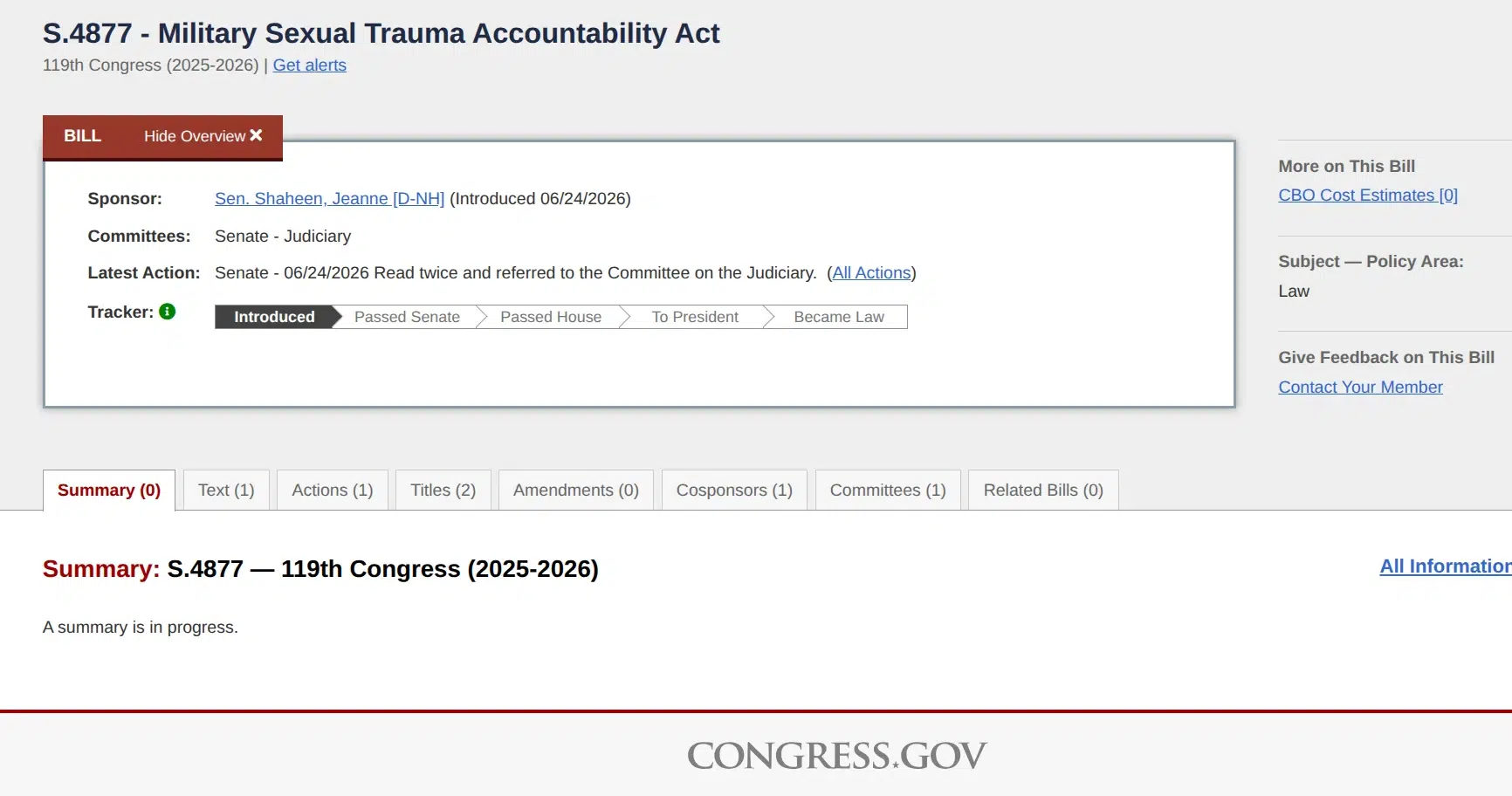
The Military Sexual Trauma Accountability Act (S. 4877) would create a path for service members and veterans to bring civil claims against the United States when government negligence contributed to military sexual trauma.
The proposal comes amid renewed scrutiny of how the military responds not only to individual perpetrators, but also to institutional failures that may allow sexual misconduct to continue.
For survivors, however, the legislation has not become law. It was introduced on June 24, 2026, and referred to the Senate Judiciary Committee.
What Would the Military Sexual Trauma Accountability Act Change?
Under current law, service members are generally prevented from suing the federal government for injuries considered “incident to military service” because of a legal rule known as the Feres doctrine.
The doctrine comes from a 1950 U.S. Supreme Court decision and has been used for decades to dismiss lawsuits brought by military personnel over service-related injuries.
For military sexual trauma survivors, the result can be especially difficult to reconcile: A civilian harmed by government negligence may be able to pursue a Federal Tort Claims Act case, while an active-duty service member harmed under similar circumstances may encounter the Feres barrier.
S. 4877 would create a specific exception for military sexual trauma.
According to the legislation, eligible service members and veterans could potentially pursue civil claims arising from:
- Sexual misconduct committed by a covered military member
- Negligent failure to prevent sexual misconduct
- Negligent failure to investigate sexual misconduct
- Other negligent or wrongful government actions that contributed to the misconduct
The proposal covers members of the Armed Forces as well as qualifying members of reserve components, the National Guard and Space Force.
Fort Hood Survivor Says the Army Failed to Protect Her
One survivor whose experience illustrates what is at stake is former Army soldier Mayra Diaz.
Diaz was stationed at Fort Hood, Texas, when Sgt. Greville Clarke entered her barracks room and sexually assaulted her in 2022, according to reporting by The War Horse.
Diaz did not know that Clarke had already assaulted other women.
Military investigators had previously failed to pursue one accusation against him after DNA evidence was inconclusive, according to Diaz’s legal claim. Even after additional attacks were reported, Diaz alleges that soldiers living in the barracks were not warned about the danger.
Clarke ultimately attacked five women. In April 2025, a military court convicted him on 29 specifications, including rape, kidnapping and attempted premeditated murder, and he received a life sentence.
Diaz left the Army after only two years. She had once envisioned making the military a career.
She has since filed a claim against the Army alleging that leadership at Fort Hood failed to provide a safe environment.
Sexual Assault Remains a Serious Issue in the U.S. Military
Thousands of reports of sexual assault continue to be made throughout the Armed Forces.
The Department of Defense received 8,195 reports of sexual assault during fiscal year 2024, including 5,169 Unrestricted Reports and 3,026 reports that remained Restricted at the end of the year. The Pentagon cautioned that the decline from the previous year could not, by itself, be interpreted as a decline in the actual prevalence of sexual assault because no prevalence survey was conducted that year.
The Department of Defense released its newer FY2025 annual report on August 12, 2026, continuing its assessment of sexual assault reporting, prevalence and prevention efforts throughout the military.
Military sexual trauma, commonly called MST, can include sexual assault as well as threatening or coercive sexual harassment experienced during military service. It can affect people of any gender, rank, branch or length of service.
What Can Military Sexual Trauma Survivors Do Right Now?
Survivors do not have to wait for Congress to act before exploring existing reporting, treatment and compensation options.
The appropriate path depends partly on whether someone is currently serving or is already a veteran.
1. Current Service Members Can Contact a SARC or SAPR Victim Advocate
A service member who experienced sexual assault can contact a Sexual Assault Response Coordinator (SARC) or Sexual Assault Prevention and Response Victim Advocate (SAPR VA).
DoD generally provides two reporting options.
A Restricted Report allows an eligible adult survivor to confidentially report the assault and receive services without automatically initiating a criminal investigation or identifying the survivor to the chain of command.
An Unrestricted Report results in military law enforcement being notified and an investigation being initiated. It can also provide access to medical care, advocacy, legal assistance and, in qualifying circumstances, an expedited transfer.
A SARC or SAPR Victim Advocate can explain both options before a survivor decides how to proceed.
2. Veterans Can File a VA Disability Claim Related to Military Sexual Trauma
A veteran who has a physical or mental health condition that was caused or worsened by MST may qualify for VA disability compensation.
This is separate from suing the military.
Veterans can file a disability claim online through the Department of Veterans Affairs, by mail, in person or with assistance from an accredited representative. Every VA regional office also has MST outreach coordinators who can assist survivors with the claims process.
Importantly, a survivor does not necessarily need to have officially reported the assault when it happened to pursue an MST-related disability claim.
The VA may consider military or civilian medical records, investigative reports, statements from fellow service members or family members, counseling records and other evidence.
For PTSD claims related to MST, the VA may also consider what are sometimes called “markers,” evidence of behavioral or life changes after the trauma. Examples can include:
- A sudden decline in military work performance
- Requests for reassignment or transfer
- Counseling or medical visits
- Relationship difficulties
- Changes in eating or weight
- Substance-use problems
- Anxiety, depression or panic attacks
- Pregnancy or sexually transmitted infection testing
- Statements from friends, relatives, roommates or fellow service members
VA guidance specifically recognizes that direct documentation of MST may not exist.
3. Survivors Can Receive MST-Related VA Care Without Filing a Disability Claim
Seeking treatment and filing for disability compensation are also separate decisions.
The VA provides MST-related health care to many eligible veterans and former service members without requiring a VA disability rating for MST. In some circumstances, MST-related care may be available even to individuals who are not otherwise eligible for VA health care.
A veteran can contact a VA medical center and ask for its MST coordinator to learn about available services.
4. Survivors Considering a Claim Against the Government Should Understand the Feres Barrier
There is also an existing process for presenting certain negligence claims against federal agencies under the Federal Tort Claims Act (FTCA). Such claims are commonly submitted on Standard Form 95 [PDF] to the federal agency allegedly responsible.
Under ordinary FTCA rules, claims generally must be presented to the appropriate agency within two years after they accrue.
For an Army-related tort claim, for example, the Army instructs claimants to contact the claims office associated with the installation or medical center where the injury occurred and generally use Standard Form 95.
But military sexual trauma cases involving service members can be fundamentally different from ordinary FTCA cases because of the Feres doctrine. Filing an administrative claim does not mean the government will accept it or that a survivor currently has the right to sue afterward.
Anyone considering this type of claim should therefore consider speaking with an attorney familiar with federal tort law and military sexual trauma as soon as possible, particularly because filing deadlines can affect legal rights.
Would the New Bill Apply to Older Military Sexual Trauma?
Potentially, yes.
One of the most significant provisions of the Military Sexual Trauma Accountability Act concerns survivors whose abuse happened before the legislation becomes law.
The bill as introduced includes provisions addressing claims that arose before enactment, potentially giving some survivors with older claims a new opportunity to pursue them. It also proposes a five-year limitations period for covered claims and would pause that period while certain investigations or proceedings are pending.
Those provisions could become particularly important for veterans who previously believed the Feres doctrine left them with no viable civil claim.
They are not available yet, however. The details could also change as the proposal moves through Congress.
The Difference Between Compensation and Accountability
For some MST survivors, VA disability compensation can provide meaningful financial support for injuries that continue long after military service ends.
But that is different from holding the federal government legally responsible for allegedly failing to prevent or investigate sexual misconduct.
That distinction is at the heart of the Military Sexual Trauma Accountability Act.
The proposed law would not simply change how a survivor receives benefits. It could, for the first time in many cases, allow a court to examine whether the military itself negligently contributed to the circumstances that allowed sexual assault or harassment to occur.
For veterans who served under the expectation that the institution would protect them, that opportunity for accountability may carry significance well beyond a monetary award.
For more information on reporting sexual abuse in the military, visit our resource article.